

Compare classic, Empire, raindrop, linear, and low-profile crystal chandeliers, then choose the right scale, light, crystals, and installation plan for your room.
The right crystal chandelier does not have to be the largest, most elaborate, or most expensive fixture in the room. It needs to suit the architecture, provide useful light, and feel appropriately scaled to the space.
Start with the room rather than the crystal label. A formal chandelier with curved arms may feel natural in a traditional dining room, while a clean cascade or linear fixture can introduce sparkle without making a modern interior feel overly ornate.
This guide explains the most common crystal chandelier styles and the practical details that matter before you buy.
Classic Crystal Chandeliers
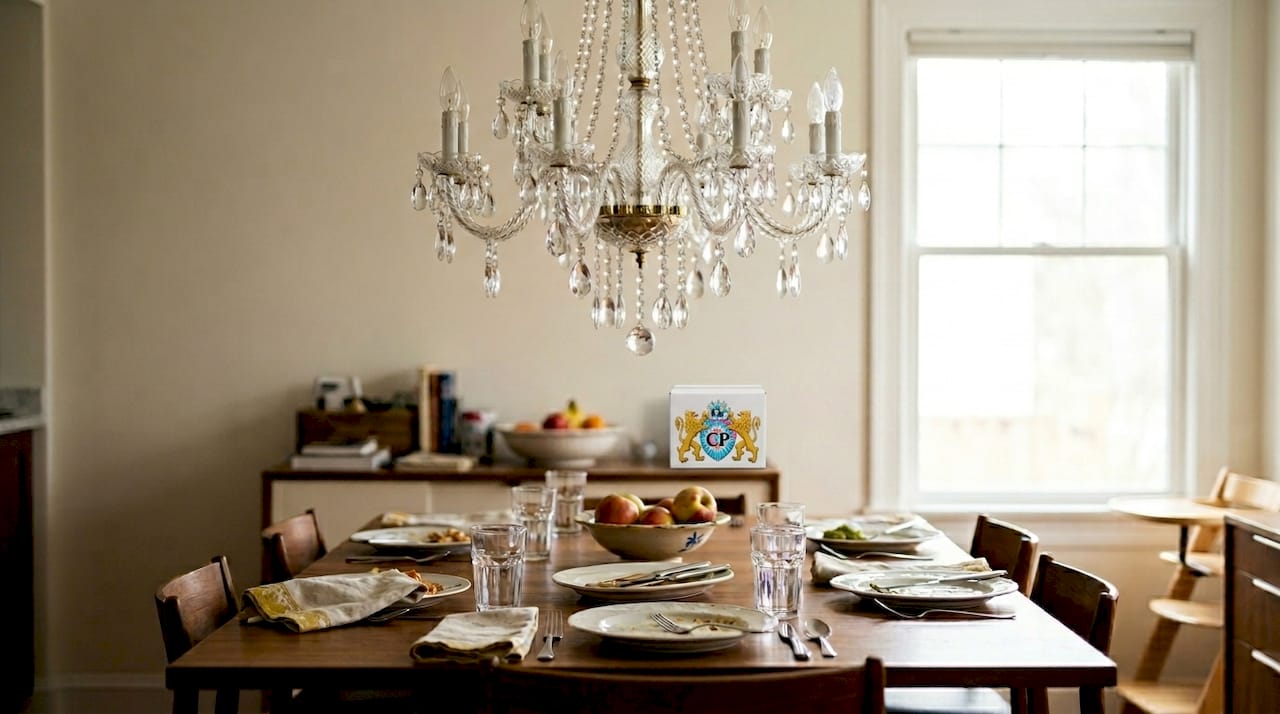
Classic chandeliers normally feature curved arms, candle-style lights, crystal chains, and hanging drops.
They work especially well in:
- Traditional dining rooms
- Formal living rooms
- Entryways
- Historic homes
- Rooms with decorative molding or detailed woodwork
The amount of crystal can vary considerably. A lightly dressed chandelier allows more of the metal frame to show, while a fully dressed fixture creates a denser, more formal appearance.
When comparing classic chandeliers, look closely at the arms, sockets, center column, crystal connections, and overall proportions. Two fixtures can use similar crystal drops and still look completely different because of their frames.
Maria Theresa Chandeliers
Maria Theresa-style chandeliers are recognized by their sweeping arms, glass-covered framework, decorative rosettes, and generous crystal dressing.
They create a romantic, formal appearance and are often chosen for dining rooms, bridal spaces, grand bedrooms, and traditional entryways.
Before buying one, consider the maintenance involved. The many arms, chains, pins, and drops produce a beautiful layered effect, but they also create more surfaces to dust and inspect.
A Maria Theresa chandelier is most successful when the room has enough visual space around it. In a small or heavily furnished room, a simpler fixture may feel more balanced.
Empire and Basket Chandeliers
Empire chandeliers usually narrow near the top, widen through the center, and draw inward again near the bottom. Crystal chains form much of the fixture’s visible shape.
Basket chandeliers use a related arrangement, with strands or bead chains creating a rounded lower section.
These styles are useful when you want:
- A strong central focal point
- A formal silhouette without exposed arms
- Dense, layered reflections
- A fixture that looks finished from several viewing angles
They can work in both traditional and transitional interiors. A dark or antique-finished frame feels more historic, while polished metal and simplified crystal strands create a cleaner appearance.
Raindrop and Cascade Chandeliers
Raindrop chandeliers use individually suspended crystals or small groups of crystals at different heights. Cascade fixtures arrange their drops in descending layers.
These styles are popular in contemporary interiors because the supporting structure can remain visually quiet while the crystals appear to float.
They work well in:
- Stairwells
- Tall entryways
- Modern dining rooms
- Rooms with simple architectural lines
- Spaces where movement is part of the design
The installation height matters. A cascade that looks graceful in a tall stairwell may hang too low in a standard-height room. Always review the fixture’s complete assembled height, including its canopy, cord, chain, and lowest crystal.
Linear Crystal Chandeliers
A linear chandelier spreads its lights and crystals across a long horizontal frame.
This shape is often a natural choice above:
- Rectangular dining tables
- Kitchen islands
- Long conference tables
- Double vanities
- Narrow seating areas
The fixture should relate to the surface below it without extending awkwardly beyond that surface. Check both its length and width, especially if cabinets, doors, or tall furniture are nearby.
A linear chandelier can deliver strong visual impact without requiring the depth of a round, multi-arm fixture.
Flush-Mount and Semi-Flush Crystal Fixtures
Low-profile crystal fixtures are useful when a traditional hanging chandelier would interfere with headroom or make the ceiling feel crowded.
A flush-mount fixture sits close to the ceiling. A semi-flush fixture leaves a smaller space between the ceiling and the main body.
These are practical options for:
- Bedrooms
- Hallways
- Closets
- Smaller entryways
- Rooms with moderate ceiling heights
“Low profile” does not always mean shallow. Crystal drops can extend well below the metal frame, so check the fixture’s full installed height rather than judging it from a photograph.
Colored and Artistic Glass Chandeliers
Clear crystal is versatile, but color can make a chandelier feel more personal.
Amber and smoky tones can warm a room. Blue, green, pink, and jewel-toned pieces create a stronger decorative statement. Colored crystal may be used throughout a fixture or added sparingly among clear pieces.
Handmade or artistic glass chandeliers can also feature flowers, leaves, scrolls, and sculptural elements. Descriptions such as “Murano” or “Venetian” should be supported by the manufacturer’s documentation and origin information rather than appearance alone.
Style and Crystal Material Are Different Decisions
A chandelier’s style describes its form. The crystal material describes the components attached to it.
The same chandelier style may be dressed with lead crystal, modern lead-free crystal, branded precision-cut components, other crystal glass, or decorative glass.
Do not assume that a material name automatically guarantees better sparkle. Appearance also depends on:
- Facet precision
- Surface polish
- Clarity
- Shape
- Crystal placement
- Condition
- Light source
- Distance between the bulb and crystal
Current Swarovski professional specifications describe its Advanced Crystal formula as having no intentionally added lead. Older chandelier components may come from different product generations, so a current specification should not be applied automatically to every vintage piece.
“K9” is commonly used as a trade description for optical glass, but the label alone does not establish a universal quality grade, manufacturer, cut, or country of origin.
For a closer material comparison, read our chandelier crystal quality guide and lead crystal guide.
How to Choose the Right Size
Common chandelier-sizing formulas can provide a starting point, but they are not universal installation rules.
Before ordering, record:
- Room length and width
- Ceiling height
- Table or island dimensions
- Fixture width
- Fixture body height
- Maximum and minimum hanging height
- Canopy dimensions
- Fixture weight
- Clearance from doors, cabinets, and walkways
Over a dining table, the chandelier should normally remain visually connected to the table instead of extending beyond it. Its hanging height should preserve comfortable sight lines for seated and standing people.
For an open room or entryway, consider how the chandelier will look from every approach. In a tall foyer, also check the view from an upper floor.
A useful test is to create a temporary outline using cardboard, paper, or painter’s tape. This makes the proposed width easier to judge than measurements alone.
Always follow the fixture manufacturer’s instructions and applicable local requirements.
Choosing Bulbs for a Crystal Chandelier
The bulb determines how the chandelier functions after the decorative decisions are made.
Check the fixture label for:
- Permitted bulb base
- Maximum wattage
- Number of bulbs
- Whether enclosed-fixture-rated bulbs are required
- Dimmer compatibility
- Recommended bulb shape
When comparing LED bulbs, use lumens to evaluate brightness rather than treating wattage as light output. The U.S. Department of Energy and ENERGY STAR explain that lumens measure brightness, while watts measure energy use.
Color temperature also affects the room. Lower Kelvin values appear warmer, while higher values appear cooler. There is no single color temperature that is best for every crystal chandelier. Select it according to the room, surrounding finishes, and desired atmosphere.
If using a dimmer, confirm that the LED bulbs, dimmer, and fixture are compatible. Incompatible combinations may flicker, buzz, or provide a limited dimming range.
Installation and Structural Support
A crystal chandelier’s weight includes the complete fixture, not only the frame. Crystals, chains, bulbs, and decorative components all contribute to the installed load.
Do not assume that an existing electrical box or mounting bracket is suitable because it previously held another light.
The support method should be evaluated using:
- The chandelier’s actual listed weight
- The mounting hardware
- The electrical box or structural support rating
- The manufacturer’s installation instructions
- Applicable local electrical requirements
Electrical Safety Foundation International recommends using a qualified, licensed electrician for home electrical work. Power should be turned off and verified before electrical conductors are handled.
A qualified installer can also determine whether additional structural support is required and whether the existing wiring, dimmer, and electrical box are appropriate.
Matching or Replacing Chandelier Crystals
When restoring an existing chandelier, match the physical component rather than relying only on a name such as “teardrop” or “pendeloque.”
Compare:
- Total height and width
- Thickness
- Facet pattern
- Hole location
- Number of holes
- Connector type
- Color
- Surface coating
- Weight
- Placement on the fixture
Photograph the crystal next to a ruler and include the connecting hardware. If several crystals are missing, photograph an intact section of the chandelier so the original pattern can be reconstructed.
Order a sample when possible before replacing an entire set.
Caring for a Crystal Chandelier
Begin with the fixture and crystal manufacturer’s instructions.
For routine care:
- Turn the light off and allow the bulbs to cool.
- Use a stable and appropriate method of access.
- Support delicate crystals while cleaning.
- Dust with a soft, lint-free cloth or suitable soft brush.
- Avoid pulling on crystal chains or twisting fixture arms.
- Keep liquid away from sockets and electrical components.
- Avoid abrasive materials and harsh cleaners.
Swarovski’s official care guidance recommends gentle handling and avoiding harsh cleaning materials. Vintage, coated, or unidentified crystals may require different care, so begin with the least aggressive method.
If the fixture is difficult to reach safely, arrange professional cleaning instead of stretching from a ladder or attempting to clean it while energized.
Frequently Asked Questions
Which crystal chandelier style works best in a modern room?
Raindrop, cascade, linear, and simplified geometric chandeliers usually integrate easily with modern interiors. A traditional chandelier can also work when its scale and finish deliberately contrast with the room.
Does lead crystal always sparkle more than lead-free crystal?
No. Composition affects optical properties, but cutting, polish, clarity, shape, condition, and lighting also matter. A precisely made lead-free component may look better than a poorly finished lead-crystal component.
Is there one correct chandelier-sizing formula?
No. Published formulas are useful starting points, but furniture dimensions, ceiling height, fixture shape, sight lines, and manufacturer instructions must also be considered.
How do I know whether my ceiling can support a chandelier?
Use the chandelier’s complete listed weight and have the mounting structure, electrical box, bracket, and hardware evaluated. Do not rely on a generic weight limit or the fact that another fixture was previously installed there.
What light bulbs make crystal sparkle?
Choose bulbs that fit the fixture specifications and provide the brightness and color appearance you want. Compare lumens, color temperature, bulb shape, and dimmer compatibility instead of selecting by wattage alone.
Can I replace chandelier crystals with a different material?
Yes, provided the replacement is compatible with the fixture. Match its dimensions, hole location, connector, weight, and placement before replacing a complete section.
Should a crystal chandelier be installed professionally?
Professional installation is the safest choice when electrical wiring, heavy fixtures, high ceilings, or structural reinforcement are involved.
Final Advice
Choose the chandelier that fits the room and the way you live in it. Style, crystal material, scale, light output, installation, and maintenance all matter more than one impressive-sounding label.
CrystalPlace has supplied chandelier crystals and replacement components since 1992. If you are trying to match a missing piece, clear photographs, exact measurements, and a picture of the complete fixture will help our team narrow the options.
Sources
- Swarovski for Professionals: Ingredient Branding, Quality, and Safety
- European Union: Crystal Glass Directive
- U.S. Department of Energy: Consumer Guide to Energy-Efficient Lighting
- ENERGY STAR: Choosing LED Bulbs
- Electrical Safety Foundation International: DIY Electrical Safety
- Swarovski: How to Care for Decorations