

Discover what is a crystal ornament and elevate your home decor with our expert guide on types, sparkle, and genuine craftsmanship.
TL;DR:
- True crystal ornaments are made from optical crystal with a higher refractive index, producing more brilliance and rainbow dispersion. The key differences include material quality, facet precision, weight, and light performance, setting genuine crystal apart from glass or imitation products. Selecting high-clarity, well-cut pieces maximizes home decoration sparkle and visual impact.
Walk into any home decor store and you’ll see dozens of sparkling ornaments all marketed as “crystal.” But pick two up and hold them to the light, and one blazes with rainbows while the other barely glimmers. The difference isn’t magic, it’s material science and craftsmanship. From true optical crystal with precision-cut facets to glass imitations and even science-project “crystal” grown from borax, the term gets used loosely. This guide cuts through the confusion so you can shop with confidence, choose pieces that genuinely transform your space, and understand exactly what you’re paying for.
Key Takeaways
| Point | Details |
|---|---|
| Crystal vs. glass | Crystal ornaments have higher refractive index and more sparkle than glass ones. |
| Variety of options | Not all ‘crystal ornaments’ are real crystal; check material and construction. |
| Lighting effects matter | Crystal ornaments transform sunlight into rainbows and light patterns indoors. |
| Choose for clarity | Prioritize clarity and cut over size to create stunning home decor effects. |
| Shop smart | Verify product details and quality when choosing crystal ornaments for your space. |
What defines a true crystal ornament?
The word “crystal” carries a lot of weight in home decor, but it doesn’t always mean the same thing. In the strictest sense, a true crystal ornament is made from optical crystal, a material formulated with specific additives that give it exceptional clarity and a significantly higher refractive index (how strongly a material bends light) than standard glass.
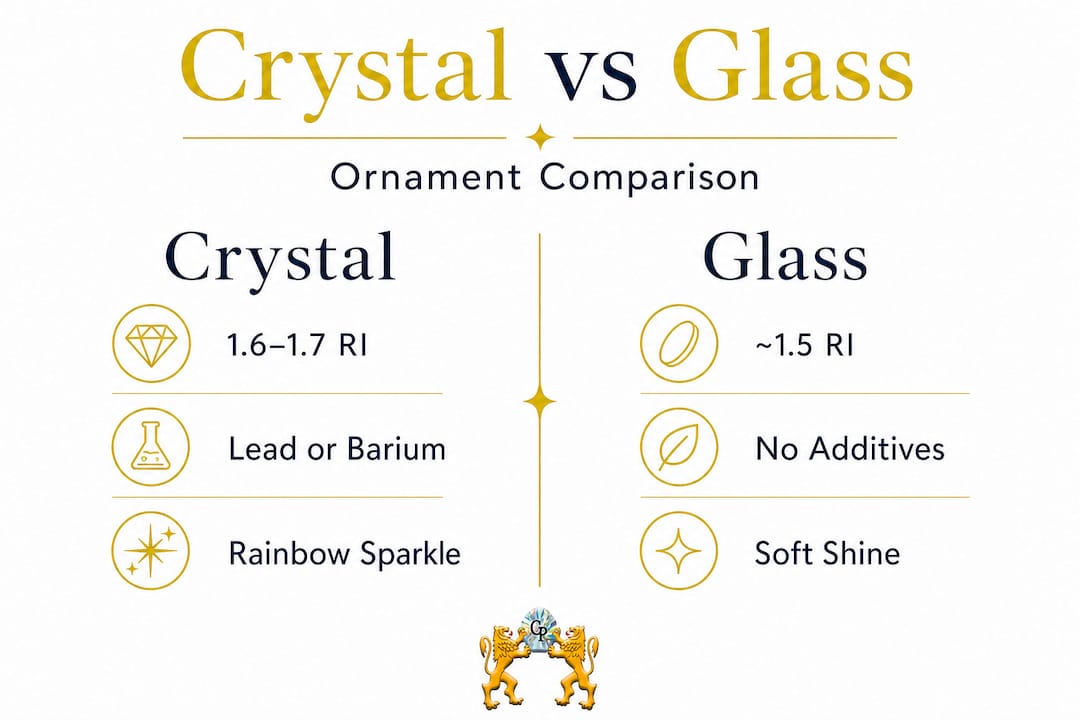
Standard glass sits around a refractive index of 1.5. True crystal, by contrast, lands in the range of 1.6 to 1.7. That small numerical gap translates into a dramatic visual difference. Higher refraction means light bends more sharply as it passes through, producing the brilliant flashes and scattered rainbow colors that make crystal decor so visually compelling.
Historically, lead oxide was the additive of choice. Lead crystal has an unmistakable weight and warmth that collectors still prize. Today, reputable manufacturers have shifted to lead-free mineral alternatives that achieve nearly identical optical performance without the environmental and health concerns. As noted in this complete guide, crystal ornaments are differentiated from regular glass by higher refractive behavior and by facet cutting that multiplies light interactions.
That facet cutting is equally important. Facets are the precisely angled flat surfaces cut into the crystal’s surface. Each facet acts like a tiny mirror and prism simultaneously, bouncing light internally, redirecting it outward at calculated angles, and splitting white light into its full spectrum. The more precise and numerous the facets, the more light interactions occur, and the more spectacular the sparkle. Hand-cut facets still outperform machine-cut ones in this regard because a skilled artisan can optimize each angle for maximum light play.
Before buying, it’s worth spotting real Swarovski crystals versus imitations, since the difference in sparkle quality is immediately apparent in person.
The single most important distinction: A true crystal ornament bends and splits light more aggressively than glass due to a higher refractive index, and its hand-cut facets multiply that effect at every surface angle. Without both properties working together, you simply don’t get the same brilliance.
Crystal vs. regular glass ornaments: a side-by-side comparison
| Property | True crystal | Regular glass |
|---|---|---|
| Refractive index | 1.6 to 1.7 | ~1.5 |
| Additives | Lead oxide or lead-free minerals | None or basic silica |
| Facet cutting | Precision hand or machine cut | Molded or minimal cutting |
| Weight | Noticeably heavier | Lighter |
| Rainbow light output | Strong, wide dispersion | Minimal or none |
| Clarity | Exceptional, often optically clear | May have slight haze |
| Typical price range | Moderate to premium | Budget to moderate |
Varieties of crystal ornaments and what they mean
Understanding materials is crucial, but labels in the marketplace add another layer of complexity. The word “crystal” appears on products ranging from museum-quality optical pieces to craft-store kits, and not all of them have anything in common beyond the name.
As this science activity guide illustrates, not all ornaments marketed as crystal are the same material. Some refer to crystal growth crafts such as borax snowflakes, where salt-like crystals form on a wire frame, while others are simply crystal-look products made from tinted acrylic or basic pressed glass.
Here’s a breakdown of the main product categories you’ll encounter:
- Optical lead crystal: Traditional, heavy, highly refractive. Made with lead oxide for premium brilliance. Less common now due to health regulations.
- Lead-free optical crystal: The modern standard for quality brands. Uses barium oxide or other minerals. Matches lead crystal’s optical performance.
- Swarovski crystal: A globally recognized brand producing lead-free crystal glass with proprietary formulations and extremely precise cutting standards.
- Crystal glass ornaments: A broad category that includes decorative glass with some additives. Quality varies widely, and many are closer to glass than optical crystal.
- Acrylic or resin “crystal” decor: Clear plastic shaped and faceted to mimic crystal. Lightweight, inexpensive, and widely sold as crystal-style ornaments.
- DIY crystal growth ornaments: Craft projects where chemical crystals (borax, alum, or salt) grow on a substrate. These are literally crystalline, but have no optical properties in common with glass crystal.
This variety matters because it directly affects what you’re buying and why. Explore crystal ornaments for home decor to see the range of genuine options, and if you’re planning seasonal displays, crystal holiday decorations offer beautiful inspiration.
Comparing construction methods at a glance
| Type | Material | Construction | Best use |
|---|---|---|---|
| Lead crystal | Glass with lead oxide | Hand cut and polished | Collector pieces, lighting |
| Lead-free optical crystal | Glass with mineral additives | Machine or hand cut | Chandeliers, suncatchers, decor |
| Swarovski crystal | Proprietary crystal glass | Precision machine cut | Premium ornaments, jewelry, decor |
| Crystal glass ornaments | Mixed glass formulas | Molded or lightly cut | Seasonal decor, gifts |
| Acrylic crystal-look | Plastic polymer | Molded | Budget decor, children’s rooms |
| DIY crystal growth | Borax, alum, salt | Grown on wire form | Kids’ crafts, STEM activities |
How crystal ornaments create sparkle and rainbow light
With the range of ornaments clarified, let’s look at why crystal decor is a designer’s secret weapon for lighting. The optical properties we’ve described don’t just look nice on a shelf. They actively change how light behaves in your entire room.
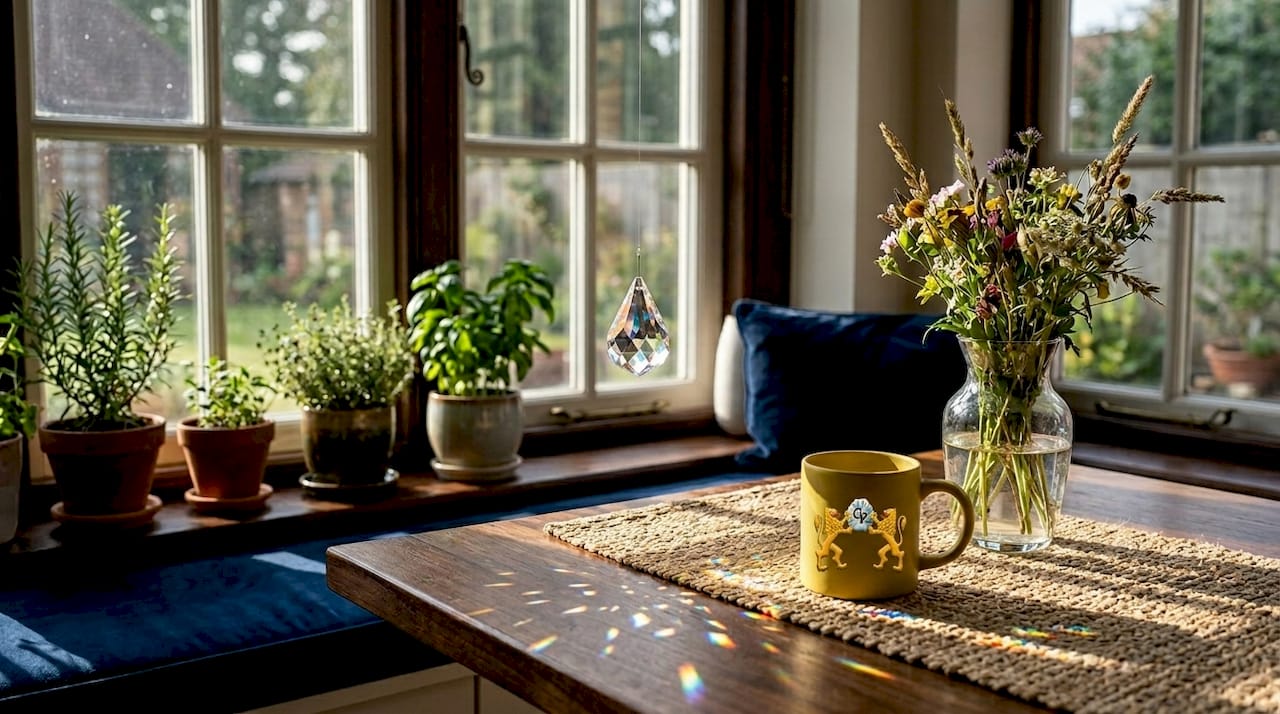
When light enters a crystal ornament, it slows down and bends. The exact angle of bending depends on the crystal’s refractive index. As light exits through a different facet at a different angle, it bends again. If those two surfaces are angled precisely, white light splits into its component wavelengths (red, orange, yellow, green, blue, violet), and those colors scatter across your walls and ceiling. This is the prism effect, and it’s the same physics behind a rainbow in the sky.
Crystal ornaments function as functional stunning crystal suncatchers when placed in windows, projecting live, moving rainbows as the sun shifts throughout the day. As noted in the Memorialight Crystal Suncatcher context, some products called crystal ornaments are actually crystal objects used specifically for light effects, where their value is the light pattern produced rather than any traditional holiday-tree format.
Here’s exactly how the light interaction works, step by step:
- Entry refraction: Light hits the first polished surface and bends inward, slowing from air speed to crystal speed.
- Internal reflection: The light bounces between internal facet walls, gaining intensity as it reflects.
- Wavelength separation: At certain angles, different wavelengths (colors) bend at slightly different degrees, beginning to separate.
- Exit refraction: Light exits through another facet, bending again. This second refraction amplifies color separation.
- Dispersion: The separated colors scatter outward at wide angles, painting your walls with rainbow light.
- Movement effect: As sunlight shifts or a breeze moves the ornament, the dispersed colors dance dynamically around the room.
For the best experience with illuminating crystal suncatchers, positioning makes all the difference.
Pro Tip: Hang crystal ornaments in east or west facing windows where morning or afternoon sun hits at a low angle. Low-angle sunlight passes through more glass surface area, producing wider and more vivid rainbow spreads than overhead midday light. South-facing windows work year-round in northern states, especially in winter when the sun stays low.
Choosing the right crystal ornament for your space
Ready to apply what you know? Here’s how to select the perfect crystal ornament for your style and home. The marketplace offers real gems and real disappointments in equal measure, so a clear checklist saves you money and regret.
Material authenticity is your first filter. When shopping, confirm the crystal type and whether the ornament is real optical crystal versus crystal-like glass or an entry-level look product. Manufacturers of genuine crystal distinguish their products by measurable sparkle, clarity, and cut precision. Imitations often look dull in natural light and lack the weight and transparency of true optical crystal.
Consider cut style for your intended use. A classic ball ornament with many small facets creates soft ambient sparkle. An elongated prism cut like an icicle focuses and throws light in a narrow beam, ideal for window sills. A teardrop or pendalogue (pear-shaped) cut combines broad refraction with a classic chandelier aesthetic. Snowflake cuts produce starburst light patterns and work beautifully in holiday displays.
Think about color versus clear crystal. Clear, colorless crystal produces the most varied rainbow effects because all wavelengths pass through equally. Colored crystal (blue, rose, amber) filters light and produces tinted pools of color rather than full spectrums. Both are beautiful. The choice depends on whether you want cool rainbow play or warm atmospheric color.
Use this shopping checklist before you buy:
- Confirm the material: optical crystal, lead-free crystal glass, or imitation?
- Check the facet quality: are cuts clean and sharp, or molded and soft-edged?
- Hold it to a light source: does it produce clear, strong rainbow dispersion or barely any?
- Verify manufacturer or brand reputation and product sourcing
- Check weight: genuine crystal feels heavier than glass or acrylic of the same size
- Read product descriptions for refractive index, lead content, and cut type
- Ask whether the ornament is hand cut or machine cut for premium pieces
Explore Swarovski suncatcher ornaments for window-specific pieces, and browse top crystal suncatchers for a curated selection of high-performers.
Pro Tip: Never pay a premium price for an ornament labeled “crystal style,” “crystal look,” or “crystal-inspired.” These terms are marketing language, not material descriptions. Real optical crystal is described with specific material terms and brand names, not vague style references.
Crystal ornaments: why clarity beats size for stunning home effects
Most shoppers walk into a decor store looking for the biggest, most ornate piece they can find. The assumption is that more crystal means more sparkle. In our experience sourcing premium crystal since 1991, that assumption leads people astray more often than not.
The truth is that a small piece of flawlessly cut, high-clarity optical crystal consistently outperforms a large piece of mediocre glass crystal. Clarity determines how much light passes through without scattering prematurely. Facet precision determines how efficiently that light gets directed and separated into color. A cloudy or poorly cut large ornament absorbs and diffuses light rather than projecting it outward. You end up with a dull, hazy glow instead of crisp, dancing rainbows.
We’ve seen customers choose a large, heavily ornate chandelier drop only to be disappointed because the crystal was low-grade and the facets were molded rather than cut. Then we’ve watched a small, precisely cut Swarovski pendalogue turn a plain window into a light show. Size simply is not the determining variable.
The pieces that look the most luxuriously expensive in a room are typically the ones with the highest refractive index and the sharpest facet edges, regardless of how large they are. A cluster of small, well-cut crystal prisms hanging in a window delivers more visual drama than a single large ornament with poor optical properties. This is why we always guide customers to evaluate cut quality and material grade before size and shape.
The take-home truth: In crystal decor, one brilliant small piece always outshines ten mediocre large ones. Clarity and cut are the only metrics that matter for real luminous impact in your home.
Enhance your décor with premium crystal ornaments
Inspired to add brilliance to your home? Here’s where to find true quality crystal ornaments for your next update.
At Crystal Place, we’ve been sourcing authentic Swarovski and premium lead-free crystal products directly from trusted manufacturers since 1991. Our collection includes everything from precision-cut crystal prisms and suncatchers for windows to chandelier drops, icicle prisms, snowflake ornaments, and clear orb forms designed to maximize light play in any room. Whether you’re refreshing a living space, styling a holiday tree with genuine sparkle, or upgrading a chandelier, our catalog carries pieces with verified material quality and real optical performance. We ship free on orders over $22 within the USA, so building out your crystal decor vision is easier than ever.
Frequently asked questions
What makes a crystal ornament different from a glass ornament?
Crystal ornaments have a higher refractive index than glass, with crystal ranging 1.6 to 1.7 compared to glass at approximately 1.5, plus precision-cut facets that multiply light effects and produce stronger rainbow dispersion.
Are all products called “crystal ornaments” actually made from real crystal?
No. As this craft guide explains, some “crystal ornaments” refer to crystal growth crafts or look-alike products, meaning the term can describe chemically grown salt formations, acrylic imitations, or genuine optical crystal with no distinction in labeling.
What is the best place to hang a crystal ornament for maximum sparkle at home?
Hang crystal ornaments in windows with direct natural light, particularly east or west facing exposures, since suncatcher crystal ornaments transform in sunlight and throw active rainbow light patterns across walls and ceilings.
How can I tell if a crystal ornament is authentic?
Look for sharp, clean-cut facets, exceptional clarity, significant weight for its size, and specific material labeling. Genuine optical crystal is marketed by sparkle and precision cut, while imitations typically look hazy, feel lightweight, and use vague “crystal style” language rather than material specifications.
Recommended
- Crystal Ornaments That Make Rooms Feel Luminous – CrystalPlace
- Holiday Sparkle: Crystal Decoration Ideas – CrystalPlace
- Crystal accessories: elevate your space with light and elegance – CrystalPlace
- Crystal lighting benefits: 30% brighter, elegant interiors – CrystalPlace