

Discover how crystals transform light, boost brightness by up to 30%, and elevate any room's ambiance. Expert tips on types, installation, and maintenance.
TL;DR:
- Crystal materials significantly enhance light reflection, dispersion, and room depth beyond standard fixtures.
- Different crystal types vary in brilliance, durability, weight, and maintenance needs, influencing design choices.
- Proper installation, bulb selection, and real-world testing are essential for achieving stunning crystal lighting effects.
Most homeowners choose lighting based on bulb type, wattage, or fixture shape. Very few stop to consider the material the light actually passes through. That oversight is exactly what separates a room that looks bright from one that feels alive. Crystals don’t just transmit light; they transform it. Through precision-cut facets, they scatter rainbows, amplify brightness, and create a sense of depth that no standard glass or acrylic fixture can match. Whether you’re designing a grand dining room or refreshing a hallway, understanding how crystal interacts with light gives you a serious edge in creating spaces that genuinely impress.
Key Takeaways
| Point | Details |
|---|---|
| Crystal amplifies light | Precision-cut crystal fixtures multiply and scatter light, creating vibrant patterns and a brighter room. |
| Lead content boosts quality | High lead crystal, like Swarovski, delivers unmatched clarity, sparkle, and durability compared to glass. |
| Ambiance customization | Crystals can add glamor to large spaces or subtle reflections to small rooms, depending on placement and type. |
| Maintenance is essential | Regular cleaning keeps crystals dazzling by removing dust that blocks refraction and shine. |
| Test for best results | Try samples under your intended lighting before buying to ensure the effect matches your vision. |
How crystal transforms light: science and spectacle
Now that we’ve set the stage for why material matters, let’s examine what makes crystal lighting uniquely impactful.
When light enters a crystal, it doesn’t just pass through. It bends, splits, and bounces between internal surfaces before exiting as a fan of color and brilliance. Each facet acts like a tiny prism, redirecting rays at precise angles. The result is a room filled with shifting patterns, soft rainbows, and an energy that changes as the day progresses.
The physics behind this comes down to something called the refractive index, which is a measure of how sharply a material bends light. Standard glass sits around 1.5, while lead crystal reaches 1.5 to 1.6 or higher, with Swarovski exceeding 1.6. That gap translates directly into visible brilliance. In fact, lead crystal delivers up to 30% more sparkle than standard glass through its precision-cut facets and superior refraction.
“Crystal amplifies brightness, projects light across surfaces, and makes spaces feel noticeably larger through bounce and dispersion.” — PAC Lights
One underappreciated benefit is that crystals multiply brightness without requiring more energy. Multiple internal reflections within each piece send light in directions a flat surface never could. A single well-placed fixture can illuminate corners, walls, and ceilings simultaneously. You can learn more about how crystal affects lighting and why the effect goes far beyond aesthetics.
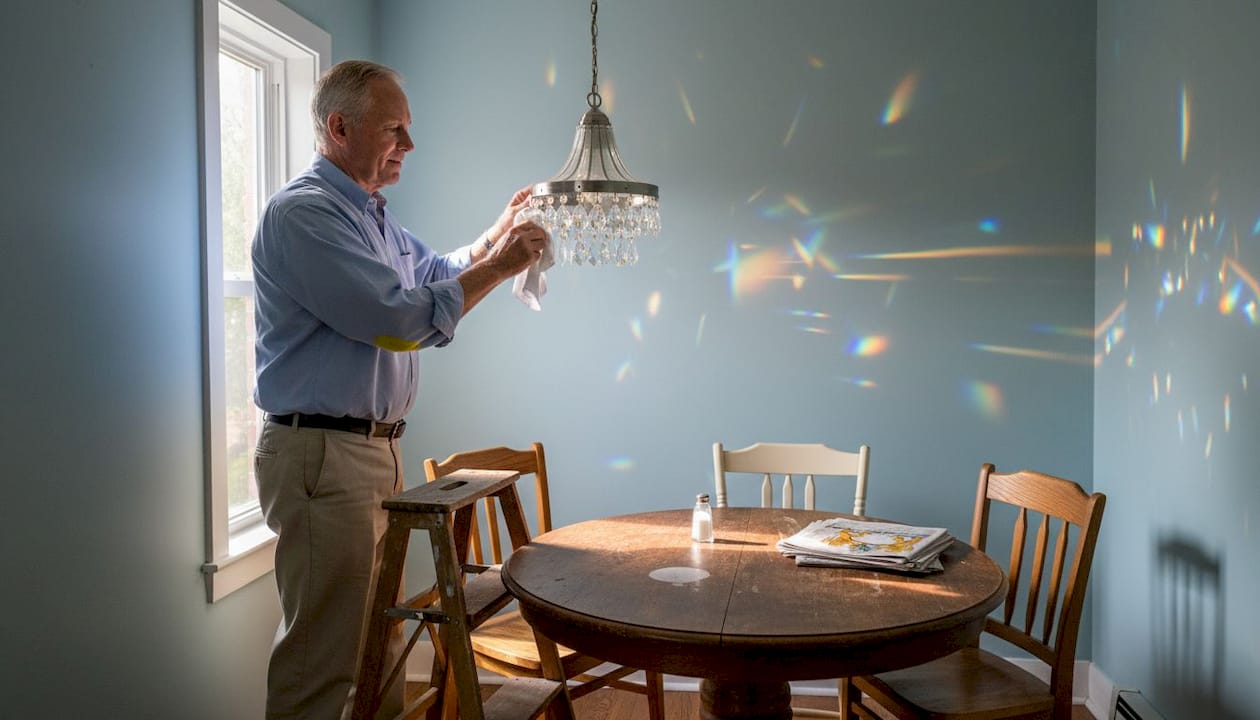
For designers working with high-end clients, luxury interior design with crystal consistently ranks among the most requested finishes, and it’s easy to see why once you’ve experienced the effect in person.
Pro Tip: Position crystal fixtures near windows or skylights. Natural light passing through crystal during the day creates rainbow patterns that shift with the sun, giving your space a living, dynamic quality that electric light alone cannot replicate.
Types of crystal used in lighting: features and differences
Understanding the science behind crystal, the next step is knowing which type best suits your needs.
Not all crystals are created equal, and the differences go well beyond price. The material you choose directly affects how much sparkle you get, how long the fixture lasts, and how much upkeep it requires.
Lead crystal requires at least 24% lead oxide, while Swarovski crystals surpass 30%, giving them unrivaled clarity and durability. K9 crystal is a borosilicate glass that’s more affordable and resistant to cracking, but it produces a softer shimmer. Glass gives moderate sparkle at a lower price point, while acrylic is the lightest and easiest to clean but lacks the fire and depth of true crystal.
For a detailed side-by-side look at Swarovski vs K9 crystals, the differences in brilliance and durability become especially clear when both are placed under the same light source.
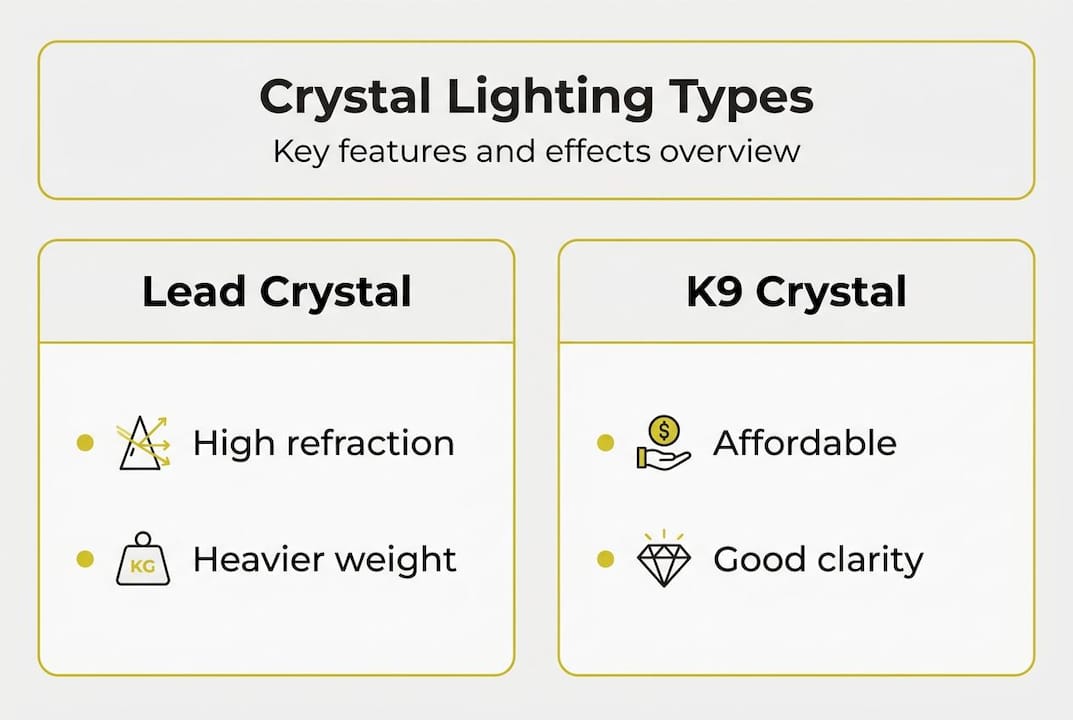
| Material | Refractive index | Weight | Scratch resistance | Light effect |
|---|---|---|---|---|
| Lead crystal | 1.5 to 1.6 | Heavy | High | Maximum brilliance |
| Swarovski | 1.6+ | Heavy | Very high | Superior sparkle |
| K9 crystal | ~1.52 | Medium | Moderate | Soft shimmer |
| Glass | ~1.5 | Medium | Low | Moderate shimmer |
| Acrylic | ~1.49 | Light | Very low | Minimal fire |
When comparing glass, crystal, and acrylic, crystal consistently outperforms in refraction and scratch resistance, though it is heavier and more sensitive to dust buildup.
Key considerations when choosing your crystal material:
- Budget: Acrylic and K9 are most affordable; Swarovski commands a premium
- Durability: Lead crystal and Swarovski resist scratching better than glass or acrylic
- Maintenance: All crystal types require regular cleaning; acrylic is the easiest to wipe down
- Visual impact: For maximum sparkle and rainbow effects, lead crystal or Swarovski is the clear choice
Pro Tip: Before committing to a full fixture or replacement crystals, request samples and hang them in your actual space under your existing bulbs. A specification sheet cannot show you how a crystal will behave in your specific room with your specific light.
Decorative and functional impact: ambiance, mood, and room dynamics
After understanding material choices, let’s see how crystals shape the entire tone and energy of a space.
Crystal lighting isn’t just decorative; it’s a functional design tool. The way a crystal fixture scatters light can make a large ballroom feel electric or a small bedroom feel softly intimate. The effect depends heavily on room size, ceiling height, and the style of the space.
Crystal enhances ambiance by multiplying brightness, creating focal points, and making rooms feel larger through light bounce and projection. A chandelier centered over a dining table doesn’t just illuminate the meal; it draws the eye upward, makes the ceiling feel higher, and anchors the entire room’s aesthetic.
“The role of crystals in ambiance goes beyond decoration. They actively reshape how light behaves in a room, turning flat illumination into a layered, dimensional experience.”
| Room type | Ceiling height | Crystal effect | Best fixture style |
|---|---|---|---|
| Dining room | 9 ft+ | Dramatic focal point | Large chandelier |
| Bedroom | 8 to 9 ft | Soft, intimate glow | Small pendant or sconce |
| Entryway | 10 ft+ | Grand first impression | Tiered chandelier |
| Hallway | 8 ft | Subtle sparkle | Crystal accent pendants |
| Living room | 9 ft+ | Layered ambiance | Multi-arm chandelier |
Small rooms need a careful hand. Too many crystals in a compact space can create visual noise and feel overwhelming rather than elegant. In those settings, a single accent piece or a few crystal fixtures for elegance work far better than a full chandelier.
For rooms where you’re still deciding, explore choosing crystal lighting to understand how fixture scale, crystal density, and placement all factor into the final result.
Creative ways to layer crystal effects:
- Pair a central chandelier with smaller crystal wall sconces to create depth
- Use crystal pendants over kitchen islands for functional sparkle
- Add crystal finials or prisms to existing fixtures as a low-cost upgrade
- Place a crystal suncatcher near a window to introduce rainbow effects without a full fixture
Using crystal lighting effectively: installation, bulbs, and maintenance
Armed with knowledge about design potential, let’s make sure your crystal lighting works flawlessly and endures.
Even the finest crystal fixture underperforms if it’s installed incorrectly or paired with the wrong bulb. Getting these details right is what separates a stunning result from a disappointing one.
Crystal fixtures are heavy. Always mount them to ceiling joists or structural beams, never just drywall anchors. For very large chandeliers, a professional electrician and a structural assessment are worth every penny.
For bulbs, warm incandescent or high CRI LED bulbs maximize crystal brilliance; regular cleaning is equally essential since dust reduces sparkle significantly. Aim for bulbs in the 2700K to 3000K range with a CRI of 95 or higher. Cool white bulbs flatten the effect and make crystal look harsh rather than warm and inviting.
For detailed guidance on crystal types and light refraction, understanding how different cuts respond to various bulb temperatures helps you make smarter purchasing decisions.
Step-by-step guide to crystal lighting success:
- Choose your crystal type based on budget, desired sparkle level, and room size
- Select the right fixture scale so it’s proportional to the room and ceiling height
- Hire a licensed electrician for installation, especially for heavy or tiered chandeliers
- Pair with warm, high CRI bulbs to bring out maximum brilliance
- Position thoughtfully near natural light sources when possible
- Clean quarterly using soft cloths or a specialized crystal cleaning solution
For a complete crystal chandelier maintenance routine, following a structured checklist keeps your fixture looking its best year after year. You can also review tips on maintaining crystal chandeliers to stay ahead of common issues.
Pro Tip: Clean crystals every three months using a soft, lint-free cloth lightly dampened with a specialized crystal cleaner. Avoid paper towels, ammonia-based sprays, or anything abrasive.
Common maintenance mistakes to avoid:
- Using harsh chemical cleaners that strip surface coatings
- Skipping regular dusting, which allows buildup to dull refraction
- Handling crystals without cotton gloves, leaving oils that attract more dust
- Ignoring loose or missing pieces that affect both aesthetics and balance
Our take: what most lighting guides overlook about crystals
Practical advice aside, our own work with crystal lighting reveals a critical, often-missed truth.
Most lighting guides stop at refractive indices and fixture dimensions. That’s useful, but it’s only half the story. The variable that actually determines whether a crystal installation looks breathtaking or just adequate is something no spec sheet can measure: how a specific crystal behaves in your specific room.
Wall color, natural light direction, ceiling texture, and even the color of your furniture all influence how crystal light scatters. A crystal that looks spectacular in a showroom with white walls and high ceilings can feel underwhelming in a room painted deep navy with low ceilings. This is why real-world testing with samples in your space is essential; no empirical benchmark replaces what your own eyes tell you under your own conditions.
“The difference between average and stunning crystal design almost always comes down to one thing: someone who took the time to test, compare, and trust their own observation over a product description.”
We’ve seen homeowners spend significantly on premium Swarovski fixtures only to be disappointed because the mounting height was wrong or the bulbs were too cool. Conversely, we’ve seen modest K9 installations look extraordinary simply because the placement was thoughtful and the bulbs were warm and bright.
If you ever get the chance to visit and experience crystal in person, take it. Seeing how different cuts and materials perform side by side under real lighting conditions is worth more than hours of online research.
The facet count, the cut angle, and even the size of each individual crystal piece all shape the final effect in ways that are genuinely hard to predict without hands-on testing. Trust the process, test your samples, and don’t skip that step.
Elevate your lighting with premium crystal fixtures
Inspired to try crystal lighting or upgrade your existing look? The right resources make all the difference.
At Crystal Place, we’ve been helping homeowners and designers find the right crystals since 1991. Our selection of authentic Swarovski and premium crystal products is curated for real results, not just catalog appeal. Whether you’re replacing a few prisms on an existing chandelier or designing a room from scratch, we offer the guidance and product range to get it right.
Browse our full collection of crystal prisms for chandeliers and discover everything from individual replacement pieces to complete fixture solutions. We offer free shipping on orders over $22 within the USA, and our team is ready to help you match the right crystal to your specific space, style, and budget. Real crystal, real brilliance, real results.
Frequently asked questions
Why are lead crystals preferred in high-end lighting fixtures?
Lead crystal offers higher refraction and durability than glass or acrylic, producing more sparkle and a longer-lasting finish in luxury lighting applications.
How do I keep crystal lighting sparkling over time?
Regular cleaning prevents dust buildup that blocks refraction; use a soft cloth or appropriate crystal cleaner every three months for best results.
Can crystal lighting make a space appear brighter?
Yes. Crystals multiply brightness through reflection and dispersion, bouncing light into corners and across surfaces that a standard fixture would leave dim.
What type of bulbs works best with crystal lighting fixtures?
Warm, high CRI LED bulbs in the 2700K to 3000K range bring out the most brilliance and warmth in crystal fixtures.
Do crystal fixtures suit every room size?
Large, formal spaces benefit most from bold crystal fixtures, but in smaller rooms, too much crystal can overwhelm; start with a single accent piece or test samples before committing to a full installation.
Recommended
- How crystal affects lighting: enhance your space with sparkle – CrystalPlace
- Why choose crystal lighting: elevate your space in 2026 – CrystalPlace
- Crystal lighting: 30% more brilliance for your space – CrystalPlace
- Crystal Fixtures: Elevate Lighting and Elegance in Any Space – CrystalPlace
- Role of Lighting in Interiors: Impact on Ambiance – New Way Ref