

Discover what is crystal bead and how to elevate your home’s lighting. Transform spaces with brilliance and stunning real crystal designs.
TL;DR:
- Authentic crystal beads are dense, cold, and produce vivid rainbow projections, unlike plastic imitations.
- Different bead shapes serve specific decor functions, with round faceted beads offering the most rainbow projection.
- Investing in premium crystal beads ensures lasting brilliance and transforms home lighting ambiance.
Walk into any room lit by authentic crystal beads and you immediately feel the difference before you can explain it. Rainbows scatter across the walls, light dances with every draft, and even a simple pendant lamp takes on a jewel-like quality that plastic or ordinary glass simply cannot replicate. Yet most homeowners shopping for crystal beads end up confused by the sheer number of options, settling for acrylic imitations that lose their appeal within a season. This guide cuts through that confusion, giving you the knowledge to choose, test, and use real crystal beads so your home’s lighting becomes something genuinely spectacular.
Key Takeaways
| Point | Details |
|---|---|
| Crystal beads create rainbows | Authentic crystal beads refract light to produce distinct rainbow effects that transform any space. |
| Look and feel matter | Premium crystals are heavier, colder, and more brilliant than glass or plastic substitutes. |
| Types shape your decor | Different crystal bead shapes offer diverse styling possibilities for various lighting and accent projects. |
| Beware common imitations | Many inexpensive beads mimic crystal, but lack the vibrant sparkle and tangible quality of the real thing. |
| Application elevates results | Creative placement of crystal beads can dramatically enhance lighting in chandeliers, suncatchers, and more. |
What defines a crystal bead?
A crystal bead is not simply any shiny bead with a hole through it. True crystal beads are produced from glass that contains a high proportion of minerals, most commonly lead oxide or, in newer formulations, barium oxide, both of which dramatically increase the material’s refractive index. That elevated refractive index is the key. It is what causes light to bend sharply inside the bead, split into its component wavelengths, and emerge as vivid rainbow projections across walls and ceilings.
The manufacturing process matters just as much as the raw material. Premium crystal beads are precision-cut with dozens of facets, each angle calculated to maximize the light’s journey through the material. Budget or “craft” beads, even when made from glass, are often molded rather than cut, leaving slightly rounded edges that scatter light weakly instead of directing it with purpose.
Here is what physically distinguishes authentic crystal beads from impostors:
- Weight: Real crystal feels noticeably dense in your palm. Acrylic or plastic beads feel almost weightless by comparison.
- Temperature: Pick up a crystal bead and it will feel cold to the touch because dense glass dissipates heat away from your skin faster than plastic.
- Surface clarity: Authentic crystal has a glass-clear, scratch-resistant surface. Plastic shows micro-scratches within months of handling.
- Sound: Tap two crystal beads together and you hear a clean, bell-like ring. Plastic produces a dull thud.
-
Light behavior: Premium vs. budget crystal shows a stark gap: top-tier beads project rainbows up to 3.2 meters across a room, while budget alternatives manage only around 0.8 meters.
Pro Tip: Hold the bead under a single-point light source such as a lamp rather than overhead fluorescents. A genuine crystal bead will throw a tight, bright rainbow. A plastic bead throws a soft, washed-out smear of color with no real definition.
Understanding these differences is the first step toward making purchases you won’t regret. Once you know what you’re feeling for and looking for, shopping for the right crystal bead types becomes far less intimidating.
Types of crystal beads and their uses in home décor
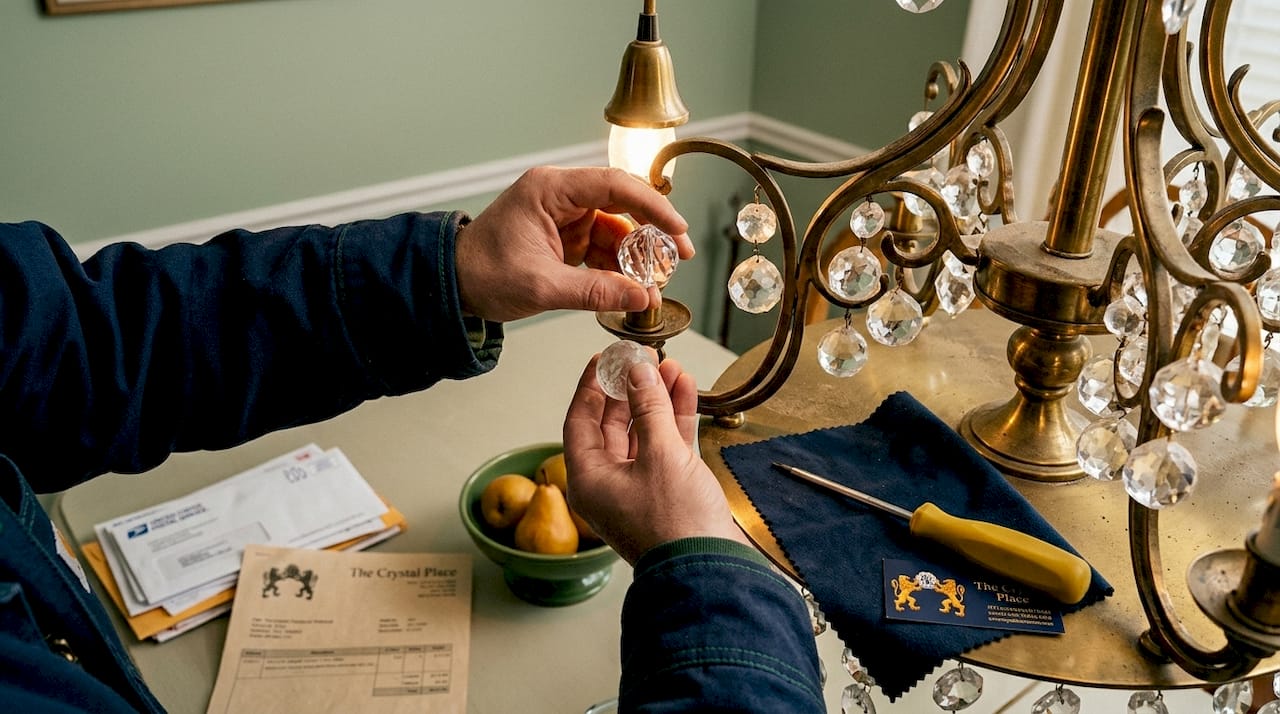
The variety of crystal bead shapes available today is genuinely impressive, and each shape serves a distinct visual and optical purpose. Choosing the wrong shape for your project is one of the most common mistakes homeowners make, usually because they are picking by looks alone rather than by function.
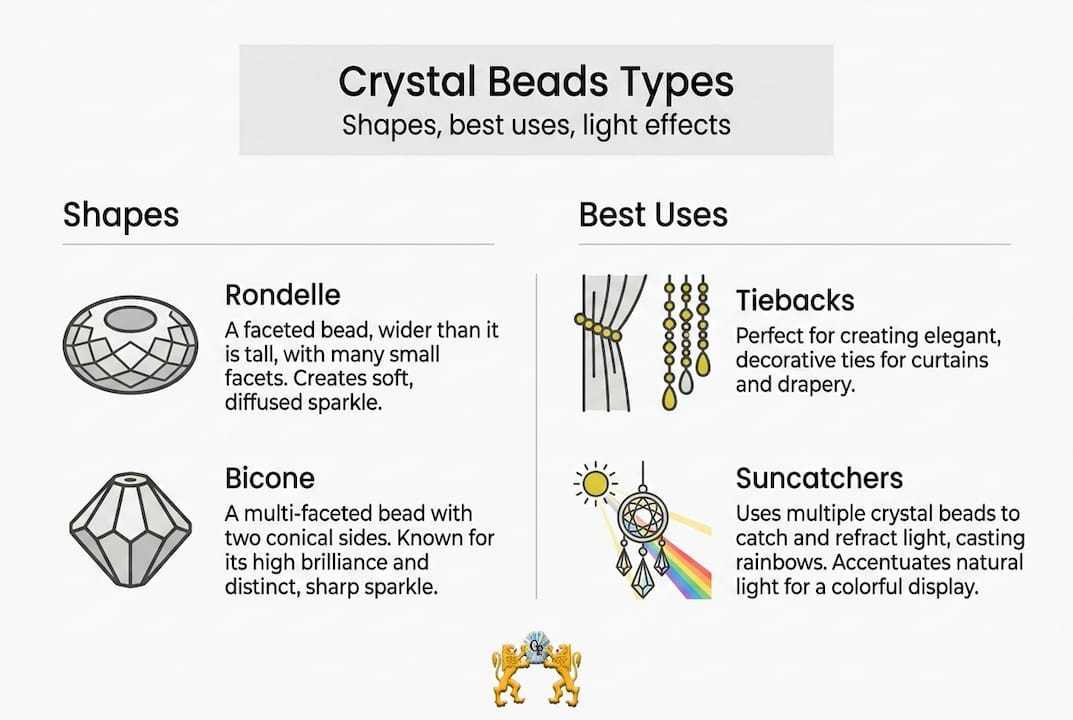
Rondelle beads are flat, disc-shaped beads with faceted edges. They catch light at sideways angles beautifully, making them ideal for strand curtains and tieback decorations where the bead hangs somewhat horizontally and needs to sparkle from many viewing positions.
Faceted round beads are probably the most versatile option in any decor setting. Their spherical shape ensures light enters from virtually every direction, and their evenly distributed facets produce consistently bright projections regardless of where light is coming from. They work beautifully on chandelier strands, pendant lamps, and suncatchers alike.
Octagon beads are eight-sided and produce a more structured, geometric light pattern. When sunlight or a focused bulb hits an octagon bead, the resulting projection has crisp, defined edges rather than a soft glow. They are the classic choice for traditional chandeliers where you want maximum formality and sparkle.
Bicone and teardrop beads add directional visual energy. Teardrops in particular draw the eye downward, making them perfect as terminal drops at the end of chandelier strands or as pendants on a window treatment.
| Bead shape | Best use | Light effect |
|---|---|---|
| Rondelle | Curtain tiebacks, garlands | Wide-angle scatter |
| Faceted round | Chandeliers, pendant lamps | Omnidirectional rainbow |
| Octagon | Traditional chandeliers, suncatchers | Geometric, crisp projections |
| Bicone | Accent strands, garlands | Linear sparkle |
| Teardrop | Chandelier drops, pendants | Focused downward brilliance |
For rooms where you specifically want maximum rainbow projection throughout the day, round faceted beads and octagon shapes are your strongest performers. The light projection difference between premium and budget versions of these shapes is substantial enough to affect how the entire room feels during daylight hours.
When budget is a genuine concern, it’s worth focusing your premium spend on the beads that will be positioned closest to your primary light source. Those are the ones doing the most optical work. For strands further from the bulb, a mid-range crystal can still add body and texture without eating your entire budget. If you want a deeper look at the full range of options and how each performs in real-world settings, our guide to choosing crystal round beads covers this in considerable detail. For context on the full landscape of what’s available, exploring premium crystal decor options can also sharpen your sense of what’s achievable.
Crystal vs. glass and plastic: How to tell the difference
This is where a lot of homeowners get burned. Online product listings frequently use the word “crystal” loosely, applying it to everything from genuine lead crystal to standard soda-lime glass to acrylic resin. Knowing how to test what you have or what you’re about to buy protects your investment and your decor choices.
| Material | Weight (relative) | Cold to touch? | Rainbow projection | Scratch resistance |
|---|---|---|---|---|
| Premium crystal | Heavy | Yes, noticeably cold | Up to 3.2m, vivid | High |
| Standard glass | Medium | Slightly cool | Minimal, soft | Medium |
| Acrylic/plastic | Light | No, room temperature | Weak, washed out | Low |
Here is a simple step-by-step test you can run on any bead before committing to a purchase:
- Weight test. Hold the bead in your palm and compare it to a standard glass bead of similar size. Crystal should feel meaningfully denser.
- Temperature test. Press the bead against the inside of your wrist for five seconds. Authentic crystal will feel cold almost immediately. Plastic stays neutral or warms up.
- Clarity test. Look through the bead at a piece of fine text. Genuine crystal produces sharp magnification with no color distortion at the edges. Cheaper materials introduce a blurry halo.
- Light projection test. Hold the bead near a focused light source in a darker room. As noted earlier, authentic crystal produces vivid, distinct rainbow projections reaching well beyond 3 meters, while imitations fall far short.
- Sound test. Gently click two beads together. Crystal rings cleanly; plastic thuds.
“The moment a customer holds a genuine Swarovski bead next to an acrylic imitation under the same lamp, the conversation is over. There is no contest.”
Pro Tip: When shopping online, look for product listings that specify the refractive index of the material. Genuine crystal typically has a refractive index of 1.52 or higher, while standard soda-lime glass sits around 1.45 and acrylic around 1.49. A seller confident in their product’s quality will have this information available.
Learning to spot real Swarovski crystals quickly is a skill that saves both money and disappointment. The differences between brands and materials are not always obvious at first glance, which is why understanding the detailed comparison between Swarovski vs generic crystals is valuable before making any significant purchase.
How to use crystal beads for stunning home lighting
Choosing the right beads is half the equation. Positioning and installation determine whether those beads actually deliver their full visual potential. There are a few core principles that separate a mediocre crystal display from one that genuinely transforms a room.
Chandelier upgrades are the most impactful application. If you have an existing chandelier that feels dated or dull, replacing or supplementing its existing crystals with premium beaded strands costs far less than buying a new fixture. Focus on adding faceted round beads to the main strands and octagon drops near the bulb positions where light concentration is highest.
DIY pendant lamps are an approachable weekend project. A simple glass pendant shade can be wrapped at its rim with a crystal bead garland, or crystal bead strands can be draped inside the shade to catch the bulb’s direct output. The effect is dramatic and costs relatively little.
Suncatchers deserve more credit than they typically receive. A suncatcher made from premium crystal beads hung in a south-facing window during the late morning hours will scatter rainbows across an entire room for two to three hours daily. This is ambient light design that requires no electricity.
Window treatments and curtain tiebacks gain an entirely new dimension when accented with crystal beads. A simple tieback strung with rondelle beads catches both direct sunlight and the reflected light off walls, creating movement and sparkle whenever a breeze stirs the fabric.
Here is how to position your beads for maximum effect:
- Hang suncatchers so they intercept direct sunlight between 9 a.m. and 2 p.m. for the longest daily performance.
- For chandeliers, position the densest bead clusters within 12 inches of each bulb.
- In rooms without strong natural light, use warm LED spotlights aimed at crystal bead panels or garlands. Warm white LEDs around 2700K bring out the amber and gold tones in crystal projections beautifully.
- Keep beads clean. Dust and fingerprint oils reduce light transmission significantly. A gentle wash with mild dish soap every few months restores full brilliance.
Pro Tip: For the most dramatic rainbow display, use a single-point light source rather than diffuse overhead lighting. A focused halogen or LED spotlight aimed at a crystal bead cluster in an otherwise dim room produces projections that feel almost theatrical.
The Swarovski crystal quality review goes deeper into why certain brands consistently outperform others in exactly these real-world installation scenarios.
What most guides miss about crystal beads
Most articles about crystal beads focus on aesthetics and give you a shopping checklist. What they rarely address is the honest, long-term value equation. After decades of sourcing, selling, and helping customers restore lighting fixtures, we have a clear perspective on where people go wrong.
The biggest mistake is treating crystal beads as a commodity purchase. When someone buys the cheapest “crystal” strands available, they are usually buying acrylic or low-grade glass that begins yellowing within two to three years. The replacement cost, time, and frustration add up fast. A truly premium crystal bead, properly cared for, will outlast the fixture it is mounted on. We have customers who are still using Swarovski beads they purchased from us in the mid-1990s. The clarity has not changed.
The second thing most guides gloss over is cleaning. Crystal beads are not high-maintenance, but they do need occasional attention. The good news is that authentic crystal is chemically inert and highly resistant to the cleaning solutions you would use on glass. Acrylic imitations, by contrast, can fog or craze when exposed to alcohol-based cleaners. This is another quiet advantage that builds over years of ownership.
There is also an emotional dimension to authentic crystal that is genuinely hard to quantify but impossible to ignore. There is something psychologically grounding about surrounding yourself with materials that respond to light in ways that feel almost alive. A room with real premium crystal upgrade elements does not just look different. It feels different. Guests notice without always knowing why. That quality is not something any budget bead can replicate, regardless of how the product listing describes it.
The light projection gap between premium and budget crystal, up to four times the projection distance, is not a small detail. It is the difference between a room that sparkles and a room that merely looks decorated.
Invest once in quality. It is almost always cheaper than replacing disappointing materials twice.
Transform your home with authentic crystal beads
Real crystal beads are one of the most cost-effective ways to elevate a room’s atmosphere, whether you are upgrading an existing chandelier, building a suncatcher from scratch, or adding delicate light-catching details to window treatments and pendants. The key is starting with genuine materials sourced from trusted suppliers.
At Crystal Place, we have been sourcing authentic crystal products directly from premium manufacturers since 1992. Our selection spans Swarovski and other high-quality crystal brands, covering everything from faceted round beads to octagons, rondelles, and specialty pendant drops. Browse our full range of crystal prisms and decor to find exactly what your project needs. With free shipping on orders over $22 within the USA, exploring what genuine crystal can do for your home has never been easier.
Frequently asked questions
What are crystal beads made of?
Crystal beads are typically made from high-quality glass with added minerals such as lead oxide or barium oxide to increase their refractive index and enhance light refracting properties, producing the vivid rainbow effects they are known for.
How can I tell if a bead is real crystal and not plastic?
Real crystal beads feel noticeably heavier and colder to the touch than plastic, and they produce vivid rainbow projections that reach across a room rather than the weak, washed-out scatter typical of acrylic alternatives.
Do crystal beads work for all types of lighting fixtures?
Yes, crystal beads can enhance chandeliers, pendant lamps, wall sconces, suncatchers, and even contemporary minimalist fixtures, adding sparkle and light-play to virtually any lighting application.
What’s the main advantage of premium over budget crystal beads?
Premium crystal beads project rainbows up to 3.2 meters across a room compared to roughly 0.8 meters for budget alternatives, and they maintain their clarity and brilliance for decades rather than yellowing or crazing over time.
Recommended
- Enhance Your Home with Crystal Interior Lighting – CrystalPlace
- Crystal lighting benefits: 30% brighter, elegant interiors – CrystalPlace
- Crystal lighting: 30% more brilliance for your space – CrystalPlace
- Crystal Bead Types: Enhance Lighting and Style with Informed Choices – CrystalPlace