

Chandelier crystals elevate interiors with unmatched brilliance. Learn crystal types, quality distinctions, design roles, and how to select the best for your home.
Finding the perfect chandelier crystals is more than a style choice—it’s the key to transforming any American home into a space that dazzles with both function and artistry. Genuine chandelier crystals, crafted from materials like rock crystal and lead crystal glass, refract and reflect light to create vibrant brilliance throughout a room. For interior designers and decorators, understanding what sets authentic crystals apart ensures every project benefits from illuminated elegance and uncompromising quality.
Key Takeaways
| Point | Details |
|---|---|
| Quality Matters | Authentic chandelier crystals enhance visual appeal through superior optical clarity, weight, and precision cutting. |
| Flexibility in Design | Customizable features of crystal chandeliers allow designers to adapt to various room styles and proportions effectively. |
| Long-Term Value | Genuine crystals are durable and repairable, maintaining their brilliance and enhancing property value over time. |
| Distinction Between Crystals | Real crystals outperform imitations in refractivity, clarity, and longevity, making them a worthwhile investment for high-end projects. |
What Makes Chandelier Crystals Unique
Chandelier crystals stand apart from ordinary decorative elements because they combine superior materials with precision engineering to create light transformation. Unlike basic glass or plastic accents, authentic chandelier crystals refract and reflect light in ways that genuinely enhance a space’s atmosphere and visual impact.
The magic happens through material quality and structural design. Rock crystal and lead crystal glass create the optical properties that make chandeliers sparkle with brilliance rather than simply glow. These materials bend light at specific angles, creating rainbow prisms and concentrated bright points throughout a room.
What distinguishes quality chandelier crystals includes:
- Optical clarity – Genuine crystals allow light to pass through without cloudiness or distortion
- Weight and density – Real crystals feel substantial, indicating proper material composition
- Precision cutting – Faceted surfaces are mathematically calculated to maximize light refraction
- Consistency – Each crystal maintains uniform quality and appearance when clustered on a chandelier
From a design perspective, chandelier crystals offer flexibility that plain fixtures cannot match. You can customize drops, adjust hanging lengths, and swap individual pieces without replacing entire installations. This modularity appeals to designers working with varying ceiling heights, room proportions, and existing décor styles.
The craftsmanship involved elevates chandelier crystals beyond mass-produced lighting. Each piece involves careful cutting, polishing, and quality inspection to ensure it meets standards for light transmission and aesthetic appeal. Chandelier crystal craftsmanship reflects techniques refined over centuries in crystal-making regions worldwide.
Another unique advantage is durability combined with repairability. Unlike integrated lighting fixtures, individual crystals can be cleaned, replaced, or reconfigured as needed. This means a quality chandelier actually improves with maintenance rather than degrading over time.
Authentic crystals maintain their brilliance for decades, making them a long-term investment that actually becomes more valuable as you care for them properly.
For interior designers, this uniqueness translates to creative control. You’re not locked into predetermined designs or limited by manufacturer specifications. Whether you need vintage restoration work or contemporary installations, crystal options adapt to your vision.
Pro tip: When evaluating chandelier crystals for your projects, examine how light passes through them in the actual space where they’ll hang, not just under showroom lighting—this reveals true optical quality and how they’ll perform in your client’s specific environment.
Types and Grades of Chandelier Crystals
Chandelier crystals come in distinct types, each offering different optical properties and manufacturing requirements. Understanding these categories helps you select the right crystals for specific design goals and budgets.
The primary distinction divides crystals into two broad categories based on composition. Lead crystal contains lead oxide, which increases the refractive index and creates exceptional sparkle with less cutting needed. Lead-free crystal (potassic crystal) delivers more subtle sparkle and follows traditional crystal-making methods, though it requires more precise manufacturing to achieve comparable brilliance.
Key differences between crystal types:
- Lead crystal – Higher refractive index, more sparkle, easier to manufacture, slightly denser appearance
- Lead-free crystal – Traditional aesthetic, subtle light play, requires precise cutting, environmentally conscious choice
- Swarovski crystals (Strass) – Superior brilliance, precision-cut facets, premium pricing, ideal for high-end projects
- Standard glass – Budget option, minimal sparkle, lacks optical depth, not recommended for luxury work
Crystal grades reflect quality standards across the industry. Lead crystal and lead-free options represent the professional-grade materials that designers specify for serious projects. Premium-grade crystals maintain consistent clarity, precise cutting tolerances, and uniform color across all pieces.
Here’s a quick comparison of chandelier crystal types and their typical uses:
| Crystal Type | Optical Performance | Typical Uses | Environmental Impact |
|---|---|---|---|
| Lead Crystal | Maximum brilliance | Luxury homes, hotels | Contains lead |
| Lead-Free Crystal | Refined sparkle | Traditional decor, eco-friendly projects | Lead-free |
| Swarovski (Strass) | Unmatched brightness | Statement pieces, high-end installations | Lead-free, premium |
| Standard Glass | Minimal sparkle | Budget fixtures, rentals | Lead-free |
For interior designers, grade distinctions matter significantly. Mid-grade crystals work well for residential installations where budget constraints exist but quality remains important. High-grade crystals suit luxury residential projects and commercial installations where brilliance and durability justify premium pricing.
Bobeches and mounting hardware also influence the overall grade perception. Quality mounting methods secure crystals firmly while remaining invisible, whereas inferior mounting hardware can rattle or allow crystals to shift over time.
Premium-grade chandelier crystals from established manufacturers carry quality guarantees and consistent optical performance across your entire installation.
Swarovski crystals represent the pinnacle of chandelier crystal options. Their precision engineering delivers unmatched brilliance and light refraction, making them the choice for statement pieces and high-visibility installations where maximum sparkle matters.
When evaluating grades, examine samples in your client’s actual lighting conditions. Artificial showroom lighting masks optical inconsistencies that become obvious under natural light or in dimly lit spaces.
Pro tip: Order sample crystals in both lead and lead-free options, then hang them in your client’s space at different times of day to compare how each type responds to their specific lighting conditions before committing to a full installation.
How Crystals Enhance Lighting and Decor
Chandelier crystals transform ordinary rooms by manipulating light in ways that plain fixtures simply cannot achieve. The interplay between light and crystal creates an atmosphere that feels both luxurious and inviting.

The magic lies in how crystals bend and redirect light. When light passes through a crystal, it refracts at multiple angles, bouncing between facets to create concentrated bright points and subtle rainbow prisms throughout the room. Crystal light refraction amplifies the perceived brightness while adding visual depth that transforms the entire space.
Practical benefits of crystal chandeliers include:
- Enhanced ambiance – Creates warmth and sophistication that changes room perception instantly
- Increased luminosity – Multiplies light output without requiring higher wattage bulbs
- Dynamic visual interest – Light patterns shift throughout the day as natural light changes
- Property value enhancement – High-quality installations appeal to potential buyers and renters
- Decorative impact – Serves as both functional lighting and stunning focal point
From a design perspective, crystals offer flexibility in creating mood. Dimmed lighting produces intimate, elegant atmospheres perfect for dining or entertaining. Brighter settings energize spaces like entryways or living rooms where vibrant ambiance matters.
The placement and density of crystals directly influence their decorative impact. A chandelier with densely packed crystals creates a more formal, dramatic effect, while sparser arrangements deliver understated elegance. This control allows designers to match crystal density to each client’s aesthetic preferences and room scale.
Chandelier crystals don’t just illuminate rooms—they transform how light itself becomes a design element that shapes the entire atmosphere and visual character of a space.
Crystal chandeliers also add timeless elegance that transcends trends. Unlike trendy lighting fixtures that feel dated within years, quality crystal installations remain visually compelling across decades and style changes.
For interior designers working on residential projects, crystals provide a way to add perceived luxury without excessive cost. A well-chosen crystal chandelier immediately signals quality and sophistication to anyone entering the space.
Pro tip: When showing crystal options to clients, demonstrate the lighting effects at different times of day and dimmer settings—daylight creates different sparkle patterns than evening lighting, and dimmed settings reveal the decorative quality that transforms the fixture from functional to statement piece.
Selecting Quality Crystals for U.S. Homes
Choosing the right chandelier crystals for American homes requires balancing aesthetics, budget, durability, and maintenance needs. Your selections should reflect both the room’s style and the practical realities of maintaining the installation over time.
Start by evaluating crystal type and composition. Lead crystal offers superior sparkle and easier maintenance, while lead-free options provide traditional aesthetics. Swarovski crystals represent the premium choice for high-end residential projects where maximum brilliance justifies the investment.
Key selection criteria for American homes:
- Room dimensions – Larger rooms accommodate bigger, more elaborate chandeliers; smaller spaces work better with modest fixtures
- Ceiling height – Standard eight-foot ceilings need compact designs; higher ceilings allow dramatic, elongated installations
- Existing décor style – Match crystal formality to room aesthetic (modern, traditional, transitional)
- Lighting needs – Consider both ambient illumination and decorative sparkle requirements
- Maintenance capacity – Frequent cleaning needs differ between densely packed and sparse crystal arrangements
Brand reputation matters significantly when selecting quality. Established manufacturers maintain consistent standards for cut precision, optical clarity, and durability. Lesser-known brands may offer lower prices but frequently deliver inconsistent quality that shows under scrutiny.
Cut quality directly affects how crystals refract light and catch the eye. Precisely cut facets multiply light reflection, while poorly executed cuts reduce sparkle and visual appeal. Run your fingers across samples to feel the precision—quality cuts feel sharp and uniform.
The best crystal selection for your client’s home balances their aesthetic vision, maintenance willingness, and budget constraints while prioritizing durability that ensures the investment remains beautiful for years.
Size and proportion deserve careful attention. Oversized chandeliers overwhelm modest rooms, while undersized fixtures disappoint in spacious areas. Standard guidelines suggest chandelier diameter should be roughly one-tenth of the room’s largest dimension.
Durability and ease of maintenance go hand-in-hand. Chandelier crystal replacements should be accessible when individual pieces need cleaning or replacement. Ask suppliers about availability of matching crystals for future repairs.
For those selecting crystals for U.S. homes, here are key factors to consider and their design impact:
| Factor | Impact on Design | Long-Term Benefit |
|---|---|---|
| Room Size | Determines chandelier scale | Ensures proportional installation |
| Ceiling Height | Influences fixture shape | Prevents overcrowding |
| Décor Style | Guides crystal selection | Achieves design harmony |
| Maintenance Needs | Affects cleaning frequency | Preserves crystal brilliance |
Pro tip: Bring paint samples, fabric swatches, and flooring photos to view crystal options under your client’s actual lighting conditions—showroom lighting often masks optical inconsistencies that become obvious once installed in residential spaces with different color schemes and natural light exposure.
Comparing Real Versus Imitation Crystals
The difference between authentic crystals and imitations dramatically affects chandelier performance, longevity, and visual impact. Understanding these distinctions helps you make informed recommendations to clients and avoid costly mistakes.
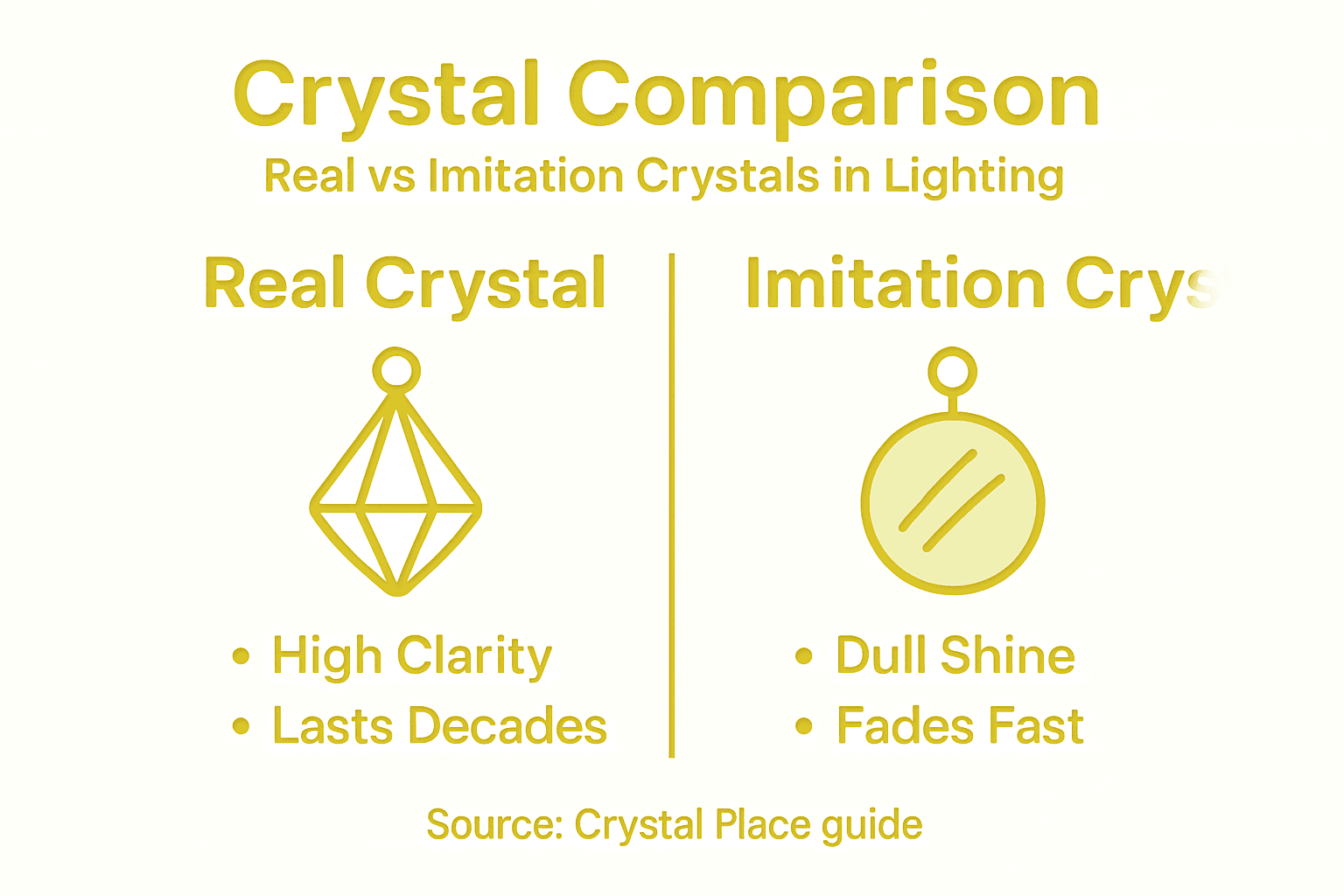
Real crystals include lead crystal and lead-free potassic crystal, both offering superior optical properties that imitation materials simply cannot replicate. Real crystal optical properties include high refractivity, distinctive weight, and characteristic clarity that creates true sparkle and light manipulation.
Key differences between real and imitation crystals:
- Refractivity – Real crystals bend light distinctly; imitations scatter light weakly or not at all
- Weight and density – Genuine crystals feel substantial and heavy; imitations feel noticeably lighter
- Durability – Real crystals withstand decades of use; imitations become brittle and cloud over time
- Optical clarity – Authentic materials maintain perfect transparency; imitations yellow, cloud, or develop haze
- Sound quality – Real crystals produce a clear ring when gently tapped; imitations sound dull or flat
- Cost – Real crystals cost more upfront but represent better long-term value
Imitation crystals typically use lower-quality glass or acrylic materials that lack the optical sophistication of genuine crystal. These materials may appear acceptable initially but degrade quickly under normal use and exposure to light.
The visual impact difference becomes obvious once installed. Real crystals create dynamic rainbow prisms and concentrated bright points that transform rooms. Imitations produce flat, lifeless light with minimal sparkle or decorative effect, disappointing clients who expected luxury.
Clients investing in chandelier crystals are paying for transformative lighting effects—imitation materials fail to deliver the optical performance that justifies the expense.
Durability represents another critical distinction. Real crystals maintain their brilliance for decades with proper care, while imitation materials become noticeably degraded within five to ten years. This longevity makes authentic crystals the better investment despite higher initial costs.
Inspecting samples reveals quality quickly. Hold real and imitation crystals up to light and observe how they refract it. Run your fingers across facets—real crystals feel precise and sharp, while imitations often have slightly rounded edges from manufacturing imprecision.
The difference between glass and crystal extends beyond material composition to encompass optical performance, durability, and aesthetic results. This distinction matters because clients trust your recommendations.
Pro tip: When presenting crystal options to clients, demonstrate side-by-side comparisons in their actual room lighting—let them observe the sparkle difference themselves rather than just describing it, which often convinces budget-conscious clients that real crystals justify the premium.
Elevate Your Space with Authentic Chandelier Crystals from Crystal Place
The article highlights the challenges of selecting real chandelier crystals that balance optical brilliance, durability, and design flexibility to transform home lighting elegance. If you want to avoid disappointment from imitation materials and achieve stunning light refraction and long-lasting beauty in your home, choosing precise cuts, authentic lead or lead-free crystals, and trusted brands like Swarovski is essential. These elements create dynamic sparkle and a luxurious atmosphere while offering ease of maintenance and repairability.
At Crystal Place, we specialize in offering a wide variety of high-quality Swarovski and authentic chandelier crystals, crystals prisms, and replacement parts. Whether you need crystal beads to upgrade your fixture, custom-designed chandeliers to fit your room dimensions and décor style, or reliable cleaning and repair solutions, we provide everything to ensure your home lighting becomes a statement of refined elegance. Experience the sustained brilliance and craftsmanship perfected since 1992 by exploring our exclusive collection.
Discover how your home’s ambiance can be transformed today.
Ready to add dazzling sparkle and sophistication to your lighting? Visit Crystal Place now to browse stunning chandelier crystals and accessories that bring your vision to life. Act now to enjoy free shipping on orders over $22 within the USA and expert guidance on crystal selection tailored to your space.
Frequently Asked Questions
What are chandelier crystals made of?
Chandelier crystals are typically made from lead crystal or lead-free crystal. Lead crystal contains lead oxide, enhancing its sparkle and refractive properties, while lead-free crystal offers a more environmentally conscious option with a traditional aesthetic.
How do chandelier crystals enhance the lighting in a room?
Chandelier crystals manipulate light by refracting and reflecting it to create dynamic effects such as rainbow prisms and concentrated bright points throughout the space, enhancing both ambiance and perceived brightness without needing higher wattage bulbs.
What distinguishes high-quality chandelier crystals from lower-quality options?
High-quality chandelier crystals feature optical clarity, substantial weight, precision cutting, and consistent quality across pieces. They also refract light better, providing more brilliance than lower-quality options like standard glass or cheap imitations.
Can chandelier crystals be replaced or repaired if damaged?
Yes, individual chandelier crystals can often be cleaned, replaced, or reconfigured, making maintenance straightforward. This allows chandeliers to remain beautiful and functional over time, unlike integrated lighting fixtures that may need to be entirely replaced.
Recommended
- Hanging Crystals for Chandeliers: Elevate Decor 2025 – CrystalPlace
- Elevate Your Chandelier Dazzling Hanging Crystals - Crystalplace.com – CrystalPlace
- Chandelier Real Crystal with Swarovski Elegance – CrystalPlace
- Elevate Your Chandelier with Crystal Garland – CrystalPlace