

Discover various crystal ornament types to enhance your home décor. Learn how to choose and use them for a year-round aesthetic!
TL;DR:
- Most crystal ornaments are versatile decor pieces suitable for year-round displays, not just seasonal use.
- Understanding the four main categories—hanging editions, suspended designs, figurines, and personalized keepsakes—helps in choosing pieces that enhance interior spaces.
- High-quality lead-free crystal offers superior sparkle and clarity, making it a worthwhile investment for long-term decor.
Most people assume crystal ornaments are seasonal items you pull out of storage every December. That assumption costs them months of potential beauty in their homes. Crystal ornament types span a far wider spectrum than holiday tree hangers, covering suspended light-catching designs, hand-cut figurines, laser-engraved keepsakes, and architectural accents that work year-round. This guide breaks down the core categories, the material and technical differences that actually matter, and how to apply each type across your interior spaces with intention.
Key takeaways
| Point | Details |
|---|---|
| Four core design categories | Crystal ornaments divide into hanging editions, suspended designs, figurines, and personalized keepsakes, each serving a distinct décor purpose. |
| Material quality affects sparkle | Lead-free crystal produces superior light refraction compared to standard glass and often requires longer sourcing lead times. |
| Facet count drives visual impact | More facets mean more light-catching angles; the Swarovski 2025 star uses 190 facets for maximum sparkle. |
| Engraving depth changes emotional value | 3D laser engraving creates dimensional depth inside crystal, making it more visually dramatic than flat 2D engraving. |
| Crystal works beyond the holidays | Spheres, prisms, and figurines placed in windows or on shelves enhance ambient lighting every season. |
Crystal ornament types: the four core categories
Understanding crystal ornament types starts with function, not just appearance. Swarovski categorizes ornaments into four distinct groups: hanging seasonal editions, suspended crystals, figurines, and personalized keepsakes. Each serves a different decorative purpose, and knowing the difference helps you buy with clarity.
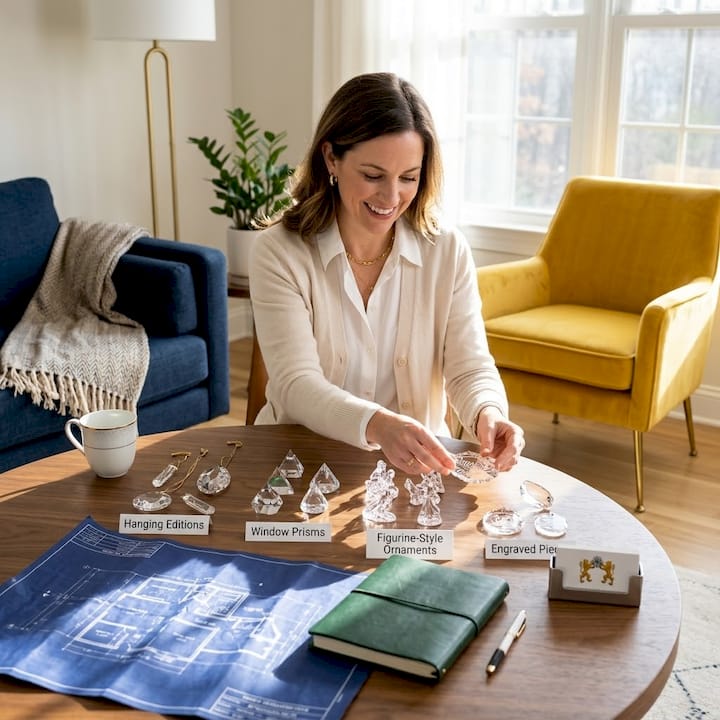
Hanging seasonal editions are what most people picture first. These are designed specifically for trees and windows, often produced annually with a dated edition marker. They are collectible by nature, intended to build value over time as part of a curated series.
Suspended crystal designs work differently. Rather than sitting on a branch, they hang freely in windows, above tables, or from chandelier frames to catch moving light. Think multi-strand crystal drops, spinning prisms, and suncatcher-style pieces. Their primary job is to interact with sunlight or artificial light and cast reflections across a room.
Figurine-style ornaments blur the line between ornament and sculpture. A crystal swan, a snowflake, or a geometric star displayed on a shelf or inside a cabinet functions more like decorative art than a seasonal accent. These are often the pieces collectors pursue most aggressively.
Personalized keepsakes occupy their own category entirely. These are crystal pieces laser-engraved with names, dates, photos, or custom imagery. They serve both as display objects and as sentimental gifts that carry long-term meaning.
- Hanging editions: best for trees, window frames, and seasonal displays
- Suspended designs: best for windowsills, curtain rods, and chandelier accents
- Figurines: best for shelves, curio cabinets, and table centerpieces
- Personalized keepsakes: best for gifting, memorials, and milestone displays
Pro Tip: If you want a crystal ornament collection that looks intentional rather than random, mix at least two category types. A figurine paired with a hanging suspended crystal creates visual contrast without competing for attention.
What the material actually tells you
Not all crystal is equal, and the difference between genuine lead-free crystal and standard glass is visible the moment light hits the surface. Lead-free crystal contains mineral compounds that increase refractive index, which is the technical way of saying it bends light more dramatically than glass does. The result is that signature sparkle you see in high-end chandeliers and premium ornaments.
Standard glass ornaments have lower clarity and produce a flat, muted shimmer by comparison. They are lighter and less expensive, which makes them practical for large-scale decorating, but they do not hold the same visual weight in a room.
Here is what to look for when evaluating crystal ornament materials:
- Clarity rating: True crystal should appear colorless and flawless at its core. Bubbles or milky streaks indicate lower-grade glass.
- Weight: Lead-free crystal feels noticeably heavier than glass of the same size. Hold two pieces of the same shape side by side and the difference is immediate.
- Light refraction: Hold the piece near a light source. Premium crystal throws sharp, rainbow-colored light across nearby surfaces. Glass produces a diffuse, washed-out glow.
- Surface texture: Hand-cut crystal has micro-facets you can feel with a fingertip. Machine-molded glass feels uniformly smooth with no texture variation.
One factor buyers frequently overlook is procurement lead time. Hand-cut, lead-free crystal ornaments from specialty producers can carry a 12-week delivery window. If you are planning a holiday installation or a staged interior redesign, ordering in late summer is not excessive. It is practical.
Pro Tip: When comparing ornament materials online, request a photo of the piece held near a lamp or window. The light refraction test is the fastest quality check you can perform without holding the piece yourself.
Design details that determine sparkle and collecting value
Once you understand the categories and materials, the next level of difference lives in the technical specs. Two ornaments can look nearly identical in a product photo and perform completely differently in your space.
How facets work
A facet is a flat, polished face cut into the surface of the crystal. Each facet acts like a tiny mirror and prism combined, capturing incoming light and redirecting it as color and brightness. More facets, cut at precise angles, multiply this effect dramatically. The 2025 annual edition star from Swarovski uses 190 precisely cut facets, making it one of the more light-intensive hanging ornaments available. For collectors, the edition year and facet count are primary identifiers of value and exclusivity.
Shapes and their décor uses
| Shape | Light Effect | Best Display Location |
|---|---|---|
| Star | Wide, directional sparkle | Tree tops, window centers |
| Sphere | 360-degree diffused glow | Shelves, bowls, table accents |
| Teardrop | Focused beam, narrow spread | Chandelier drops, curtain tie-backs |
| Prism | Rainbow spectrum projection | Windowsills, direct sunlight |
| Snowflake | Scattered multi-directional sparkle | Windows, garland accents |
Display hardware matters more than people realize
How an ornament hangs or sits affects its visual performance. A piece designed for a hinged keepsake format opens to reveal an interior and sits flat on a surface rather than hanging. Finial-shaped ornaments taper to a point and work at chandelier drop positions where a rounded ornament would look out of place. Ribbon-hung ornaments have a different sway characteristic than wire-hooked ones, which changes how they catch moving air and ambient light.
- Finials: ideal for chandelier assembly and formal lighting fixtures
- Ribbons: soft, flowing hang suited to garlands and holiday trees
- Wire hooks: minimal visual interference, best for maximalist ornament displays
- Hinged keepsakes: tabletop or shelf display with an opening compartment
Personalized crystal ornaments: 2D vs 3D engraving
Personalized crystal ornaments have become one of the most searched popular crystal ornament styles because they combine decorative appeal with emotional meaning. But the engraving technology behind them is genuinely misunderstood, and the wrong choice leads to disappointment.
The core distinction is dimensionality. 2D engraving creates an image on a single internal plane inside the crystal. The result is sharp, clean, and legible from straight on, similar to looking at a photograph through glass. It works exceptionally well for text, logos, line drawings, and simple portraits.
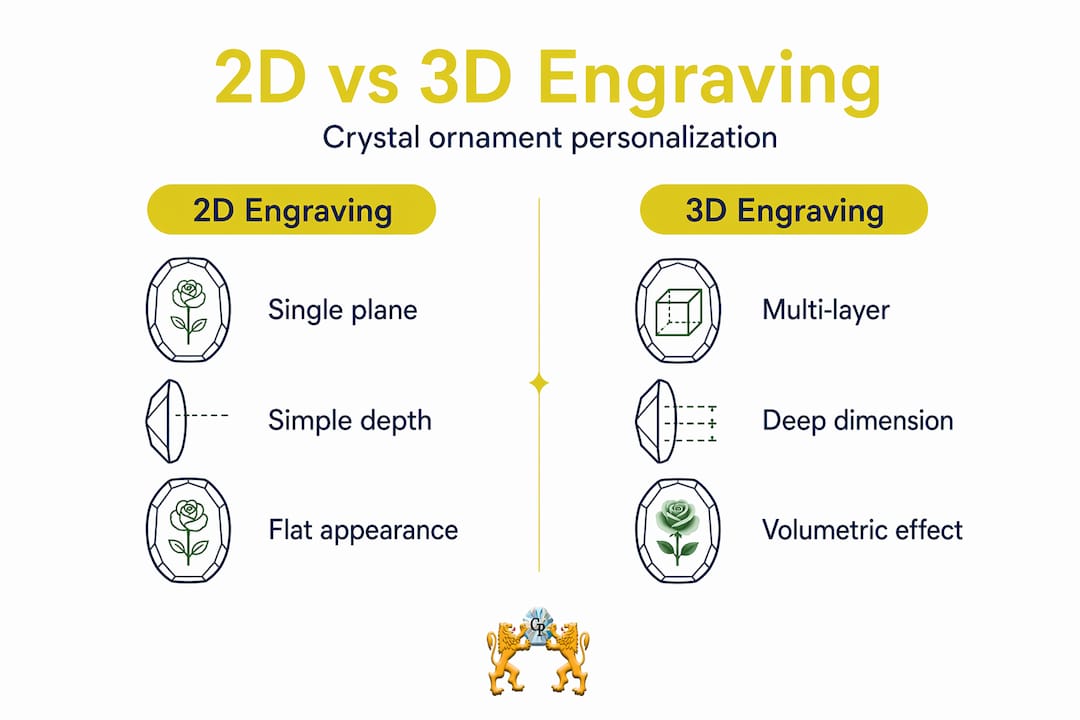
3D engraving uses a laser to etch the image across multiple internal layers, building depth along the X, Y, and Z axes inside the crystal body. The result is a sculpted, volumetric image that appears to float inside the piece. 3D engraved pieces are favored for anniversaries, romantic keepsakes, and memorials because the added realism creates stronger emotional impact.
| Feature | 2D Engraving | 3D Engraving |
|---|---|---|
| Image depth | Single plane, flat appearance | Multi-layer, volumetric depth |
| Best for | Text, monograms, line art | Photos, portraits, detailed scenes |
| Viewing angle | Best viewed straight on | Engaging from multiple angles |
| Price point | More affordable | Higher cost due to complexity |
| Emotional impact | Clean and personal | Immersive and dramatic |
Pro Tip: For a gift that will be displayed year-round rather than stored seasonally, choose 3D engraving and a shape that suits a shelf or windowsill, like a cube or sphere. The multi-angle viewing makes it interesting every time someone walks past it.
Styling crystal ornaments beyond the holiday tree
This is where understanding different crystal ornaments pays off in real daily living. The unique crystal decor options available today were never meant to be used only in December. Here is how to deploy each type across your interior spaces with purpose.
Windows and natural light. Prism-cut ornaments and spheres placed directly in a south or west-facing window will cast moving rainbow light across walls and ceilings throughout the afternoon. Hang them at different heights to create layered light effects. The movement of natural light throughout the day keeps the display interesting without any effort.
Chandelier accents. Adding crystal drops, finials, or teardrop ornaments to an existing chandelier is one of the fastest ways to upgrade a lighting fixture without replacing it. Crystal placement in chandeliers amplifies both natural and electric light, increasing the visual warmth of a room at night.
Shelf and cabinet styling. Figurine-style crystal ornaments placed among books, plants, or ceramics add reflective contrast to otherwise matte surfaces. Group an odd number of pieces in varying heights for the most natural arrangement. A crystal sphere next to a candle creates an interaction between flame and reflection that is genuinely striking after dark.
Seasonal swaps without storage hassles. Rather than fully replacing décor by season, swap out hanging ornament colors or sizes while keeping your core arrangement intact. Swap clear crystal prisms for colored ones in spring, or add larger spheres in winter to increase the sense of warmth and weight in the room.
- Place suspended crystals at varying heights to create depth in windows
- Use figurines as anchors in styled shelf vignettes alongside plants and books
- Add crystal drops to pendant lights for a chandelier effect without the fixture cost
- Mix ornament sizes deliberately: large spheres as base, small teardrops as accents
My honest take on crystal ornament choices
I’ve spent years looking closely at how people shop for and display crystal ornaments, and the most common regret I hear is buying on impulse without understanding the type distinctions. Someone picks up a beautiful glass ornament at a seasonal market, loves it in the moment, and then wonders six months later why it looks flat compared to what they see in interior design photos. The answer is almost always material quality and facet design.
What I’ve learned is that one well-chosen lead-free crystal piece does more for a room than a dozen generic glass ones. The light interaction is not subtle. It changes the visual temperature of a space in a way that photographs honestly cannot capture. You have to see a prism-cut sphere in afternoon sun to understand what the fuss is about.
My other strong opinion: the 2D vs 3D engraving decision is not just about budget. It is about how the piece will be viewed. A 2D engraving looks sharp and intentional when displayed in a dedicated spot with direct lighting. A 3D engraving rewards casual observation from across the room. If the ornament will live on a shelf where people walk past it daily, the 3D option earns its higher price every single day. I have never heard someone regret upgrading to 3D. I have heard plenty of people wish they had.
Think beyond the holidays. Your crystal pieces deserve more than eleven months in a box.
— BCC
Explore Crystalplace’s crystal ornament collection
If this guide has clarified what you are actually looking for, Crystalplace makes the next step straightforward. Since 1991, Crystalplace has sourced authentic crystal products directly from trusted manufacturers, with a catalog built around the kinds of quality distinctions covered in this article.
Whether you are looking for hanging crystal prisms for a chandelier upgrade, suspended suncatchers for a window display, or decorative finials and drops to refresh existing lighting, Crystalplace stocks an extensive range organized by shape, size, and material. All orders over $22 ship free within the USA, and the selection covers everything from single accent pieces to bulk orders for larger installations. Browse the full collection to find the exact crystal ornament types and formats that match your space and your vision.
FAQ
What are the main crystal ornament types?
Crystal ornaments fall into four main categories: hanging seasonal editions, suspended light-catching designs, figurine-style display pieces, and personalized laser-engraved keepsakes. Each type serves a distinct decorative function and display context.
How is lead-free crystal different from regular glass ornaments?
Lead-free crystal has a higher refractive index than standard glass, producing sharper light refraction and more intense sparkle. It also tends to be heavier and clearer, with a more defined light response in both natural and artificial lighting.
What does facet count mean for a crystal ornament?
Facet count refers to the number of flat polished surfaces cut into the crystal. More facets at precise angles produce more light-catching points, increasing sparkle and visual complexity. The 2025 Swarovski annual edition uses 190 facets as a benchmark for premium light performance.
Which is better for a gift: 2D or 3D engraved crystal?
3D engraving is the stronger choice for emotional gifts like anniversaries or memorials because the volumetric depth creates a more immersive, realistic image visible from multiple angles. 2D engraving works well for text, monograms, or clean graphical designs where clarity matters more than depth.
Can crystal ornaments be used as year-round home décor?
Absolutely. Spheres, prisms, and figurines placed in windows, on shelves, or incorporated into lighting fixtures work as permanent interior accents. Their light-refracting properties make them as functional as they are decorative, regardless of season. Explore crystal ornament decorating ideas to see how different types suit various interior styles throughout the year.
Recommended
- Crystal ornaments: types, sparkle, and home decor uses – CrystalPlace
- Crystal Ornament Decorating Ideas for Every Home Style – CrystalPlace
- Elegant crystal ornaments: Stunning examples for home décor – CrystalPlace
- How crystal ornaments elevate lighting and home décor – CrystalPlace