

Master custom crystal chandelier design with expert guidance on sizing formulas, crystal selection, manufacturer collaboration, and maintenance for lasting brilliance.
Designing a custom crystal chandelier transforms any interior space into a luminous showcase of elegance and sophistication. Yet achieving the perfect balance of size, brilliance, and style demands careful planning across multiple technical and aesthetic dimensions. From calculating ideal proportions for your room to selecting crystals that maximize light refraction, each decision shapes the final impact. This guide walks you through sizing formulas, crystal type comparisons, manufacturer collaboration strategies, and maintenance routines that keep your chandelier sparkling for decades. Whether you’re an interior designer crafting a signature statement piece or a homeowner seeking to elevate your living space, these insights ensure your custom chandelier delivers both visual drama and lasting performance.
Key Takeaways
| Point | Details |
|---|---|
| Sizing uses room dimensions | Calculate chandelier diameter by adding the room length and width in feet and converting the sum to inches, then adjust for ceiling height and layout. |
| Lead and Swarovski crystals | Lead and Swarovski crystals provide higher light refraction, boosting sparkle and perceived brightness. |
| Involve manufacturer early | Engaging the maker during concept and prototype stages helps avoid design mistakes and costly redesigns. |
| Routine cleaning matters | Regular cleaning prevents light loss and keeps crystal sparkle over time. |
Understanding chandelier size and space requirements
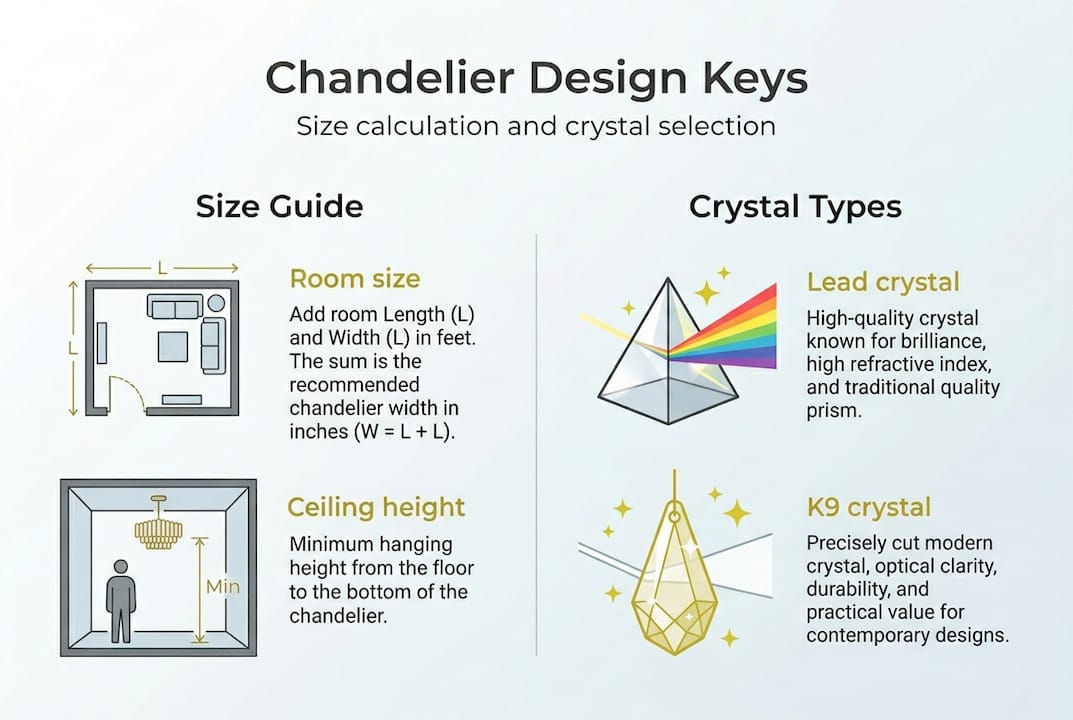
Selecting the right chandelier size begins with a straightforward calculation that ensures proportional harmony between fixture and room. The standard sizing rule for crystal chandeliers involves adding your room’s length and width in feet, then converting that sum to inches for the ideal diameter. A 12-foot by 15-foot dining room yields 27 inches, providing a fixture that commands attention without overwhelming the space. This formula works reliably for rooms with standard 8 to 10 foot ceilings and balanced proportions.
Ceiling height introduces critical adjustments to this baseline calculation. Rooms with 12 foot or higher ceilings require larger fixtures to maintain visual weight and prevent the chandelier from appearing undersized. Double-height spaces and cathedral ceilings demand fixtures scaled 1.5 to 2 times the standard calculation, ensuring the chandelier fills vertical space appropriately. Sloped ceilings present unique challenges, often requiring custom mounting solutions like adjustable rods or swivel canopies that maintain level orientation while accommodating the angle.
High ceiling installations benefit from specialized hardware that simplifies maintenance and bulb replacement. Motorized lowering systems allow you to bring the chandelier down to floor level for cleaning and service, eliminating dangerous ladder work. Ceiling adapters and extension rods provide cost-effective alternatives for moderately tall spaces, though they require professional installation to ensure proper weight distribution and electrical safety. These solutions prove especially valuable in foyers and stairwells where access remains limited.
Safety considerations extend beyond mounting hardware to encompass room usage patterns and occupant needs. Homes with young children should position chandeliers high enough to prevent contact during active play, typically maintaining 7 feet of clearance above the floor in circulation areas. Dining room installations require 30 to 36 inches between table surface and fixture bottom, allowing diners to see across the table without glare while protecting the crystals from accidental impact. Specialized wiring for dimmer compatibility and smart home integration should be planned during initial installation, as retrofitting often proves more expensive and disruptive.
Room type sizing comparison:
- Dining rooms: Add dimensions, hang 30-36 inches above table
- Foyers: Use 1.5x standard formula for double-height spaces
- Living rooms: Calculate based on seating area, not total room size
- Bedrooms: Scale down 20% from formula for intimate ambiance
Pro Tip: For open concept spaces, treat each functional zone as a separate room when calculating chandelier size, then select fixtures that create visual rhythm without competing for attention.
Selecting the right crystal type for brilliance and style
Crystal selection determines the quality and character of light refraction that defines your chandelier’s sparkle. Lead crystal and Swarovski crystals contain 20-30% lead oxide content, producing the prismatic brilliance that separates premium fixtures from standard lighting. This high lead oxide concentration increases the refractive index to 1.54 through 1.70, compared to standard glass at 1.45 to 1.52, creating the rainbow dispersion and fire that makes crystals dance with light. Swarovski crystals push this further with 30% or higher lead content and precision machine cutting that ensures every facet aligns perfectly for maximum optical performance.

K9 and other lead-free crystal alternatives offer budget-conscious options with respectable light performance. These crystals achieve refractive indices around 1.50 to 1.56 through alternative mineral compositions, delivering noticeable sparkle without the premium price point of lead crystal. While they lack the intense fire and weight of traditional lead crystal, K9 crystals suit modern minimalist designs where clean lines and subtle elegance take precedence over maximum brilliance. Environmental and health regulations in some jurisdictions favor these lead-free options, making them practical choices for commercial installations and public spaces.
Matching crystal type to your chandelier’s overall design language ensures cohesive visual impact. Traditional and ornate fixtures benefit from the rich sparkle of lead or Swarovski crystals, where elaborate cuts and heavy faceting create dramatic light displays. Contemporary and transitional designs often pair better with K9 crystals or even optical glass, where understated elegance and geometric precision align with minimalist aesthetics. The crystal’s shape matters equally, with teardrop prisms, octagon beads, and icicle pendants each producing distinct light patterns and visual textures.
| Crystal Type | Lead Content | Refractive Index | Best For | Price Point |
|---|---|---|---|---|
| Lead crystal | 20-30% PbO | 1.54-1.65 | Traditional designs | $$$ |
| Swarovski | 30%+ PbO | 1.65-1.70 | Luxury fixtures | $$$$ |
| K9 crystal | Lead-free | 1.50-1.56 | Modern minimalist | $$ |
| Optical glass | Lead-free | 1.45-1.52 | Contemporary | $ |
Photometric considerations extend beyond crystal type to encompass bulb selection and placement. Warm LED bulbs at 2700K color temperature enhance crystal sparkle while providing energy efficiency and long service life. Positioning bulbs to direct light through crystal facets rather than around them maximizes refraction, creating the signature chandelier glow. Dimming capability allows you to adjust light intensity for different occasions, though not all LED bulbs dim smoothly, requiring compatible fixtures and controls.
Crystal selection factors:
- Light source: LED bulbs require crystals optimized for cooler color temperatures
- Room finish: Dark walls benefit from higher refractive index crystals
- Viewing distance: Larger rooms need bigger crystal elements for visible sparkle
- Maintenance access: Consider cleaning requirements for intricate crystal shapes
Pro Tip: Request sample crystals from your manufacturer and view them under your actual lighting conditions at different times of day, as showroom lighting rarely matches residential settings and can misrepresent how crystals will perform in your space.
Explore detailed crystal type comparisons and review brilliance examples to understand how different materials transform light in real-world applications.
Collaborating on design and installation with manufacturers
Early manufacturer involvement prevents costly mistakes and ensures your custom chandelier meets structural and aesthetic requirements. The custom design process benefits from manufacturer input during initial concept development, particularly for load calculations that determine whether your ceiling can support the fixture’s weight. Crystal chandeliers often weigh 50 to 200 pounds or more, requiring reinforced junction boxes and structural support that standard electrical boxes cannot provide. Manufacturers can specify exact mounting requirements and recommend reinforcement strategies before construction begins.
Photometric modeling reveals how your chandelier will illuminate the space under various conditions. Advanced manufacturers use computer simulations to predict light distribution, shadow patterns, and brightness levels throughout the room. These studies identify potential issues like dark corners, excessive glare, or insufficient task lighting before fabrication begins. Adjusting crystal placement, bulb count, or fixture geometry during the design phase costs nothing compared to modifications after installation. Request photometric reports that show illumination at table height, on walls, and at floor level to ensure the design meets your functional needs.
Climate and environmental factors influence material selection and finish durability. Coastal locations with salt air require corrosion-resistant finishes and sealed electrical components to prevent degradation. High humidity environments benefit from stainless steel or brass frames with protective coatings rather than standard metal finishes. Manufacturers familiar with regional conditions can recommend appropriate materials and treatments that extend fixture lifespan. Temperature extremes in spaces like sunrooms or near fireplaces may require heat-resistant wiring and crystal adhesives that maintain integrity under thermal stress.
Design collaboration best practices:
- Share detailed room photos including ceiling structure and existing wiring
- Provide accurate measurements of room dimensions, ceiling height, and obstacles
- Discuss lighting goals: ambient, task, accent, or dramatic effect
- Review structural drawings with manufacturer engineer before finalizing design
- Establish timeline expectations for design, fabrication, and installation phases
- Confirm warranty coverage and post-installation support services
Common pitfalls include ignoring existing wiring limitations and making late-stage design changes. Most homes have standard 15-amp circuits that limit total wattage, restricting bulb count and brightness levels. Upgrading to 20-amp dedicated circuits during renovation provides flexibility for larger fixtures and future modifications. Design changes after fabrication begins often require scrapping completed components and restarting production, adding weeks to delivery and substantially increasing costs. Lock down all design elements including crystal type, finish, dimensions, and bulb specifications before authorizing production.
“The most successful custom chandelier projects involve the client, interior designer, and manufacturer in a three-way conversation from day one. This collaboration ensures everyone understands the vision, constraints, and technical requirements before any metal gets cut or crystals get ordered.” - Industry design expert
Pro Tip: Request a full-scale cardboard or foam mockup of your chandelier design and hang it in the actual space for several days, allowing you to assess size, proportions, and visual impact from all angles before committing to fabrication.
Review comprehensive chandelier replacement guidance for additional insights on working effectively with manufacturers and installers.
Maintaining and restoring custom crystal chandeliers for lasting brilliance
Regular cleaning prevents the gradual light loss that accumulates as dust and grime coat crystal surfaces. Research shows chandeliers can lose up to 40% of their light transmission over 12 months without cleaning, dramatically reducing sparkle and brightness. Establish a cleaning schedule based on your environment: every 3 months in dusty or high-traffic areas, every 6 months in typical residential settings, and annually in climate-controlled spaces with minimal dust. Use distilled water and ammonia-free crystal cleaner to avoid mineral deposits and finish damage, applying solution with microfiber cloths that won’t scratch delicate surfaces.
LED bulb selection impacts both energy efficiency and light quality. Choose 2700K warm white LEDs that mimic traditional incandescent color temperature, enhancing crystal sparkle without the harsh blue cast of cooler LEDs. Dimmable LED bulbs require compatible dimmer switches designed for LED loads, as standard incandescent dimmers cause flickering and premature bulb failure. Quality LED bulbs last 15,000 to 25,000 hours compared to 1,000 hours for incandescent, reducing maintenance frequency and long-term costs despite higher initial prices.
Crystal replacement and repair constitute approximately 80% of chandelier restoration work. Individual crystals crack or chip from impact, thermal stress, or manufacturing defects, creating dark spots in the light pattern. Replacing damaged crystals requires matching the exact size, cut, and quality to maintain visual uniformity. Keep spare crystals from your original order for future repairs, as manufacturers change product lines and finding exact matches years later proves difficult. Missing or broken metal pins and connectors also require attention, as these small components secure crystals and prevent them from falling.
Maintenance essentials:
- Clean crystals every 3-6 months with distilled water and specialized cleaner
- Inspect wiring annually for fraying, discoloration, or loose connections
- Replace LED bulbs as needed, maintaining consistent color temperature
- Tighten mounting hardware and check ceiling support every 2 years
- Professional inspection every 5 years for fixtures over 100 pounds
Restoration strategies focus on returning aged chandeliers to original brilliance through systematic crystal replacement and finish renewal. Oxidized metal frames benefit from professional refinishing that strips old lacquer, polishes the base metal, and applies fresh protective coating. Upgrading all crystals to higher quality materials transforms vintage fixtures, replacing cloudy or yellowed glass with authentic lead crystal that dramatically improves light performance. This approach proves especially valuable for inherited or antique chandeliers with sound structural frames but degraded decorative elements.
Pro Tip: Create a simple diagram of your chandelier’s crystal pattern with measurements and quantities for each crystal type, making future repairs and replacements straightforward even years after installation when memory fades and documentation gets misplaced.
Consult the detailed cleaning checklist and comprehensive maintenance guide for step-by-step instructions that preserve your chandelier’s beauty and performance.
Enhance your chandelier with premium crystal selections
Your custom chandelier design deserves the finest crystal components that maximize brilliance and longevity. Whether you’re completing a new installation or refreshing an existing fixture, premium crystal prisms and ornaments elevate light refraction to stunning levels. Authentic Swarovski crystals and precision-cut lead crystal elements create the signature sparkle that defines luxury lighting.
Explore curated collections of crystal ornaments and suncatchers designed specifically for chandelier enhancement. Each piece undergoes rigorous quality inspection to ensure flawless clarity and optimal light performance. Browse the complete selection of crystal prisms and decorative elements to find components that match your design vision. Expert support helps you select the right crystals for your specific fixture, ensuring compatibility and visual harmony. Free shipping on orders over $22 makes it easy to stock replacement crystals and experiment with new configurations that refresh your chandelier’s appearance.
Frequently asked questions
How do I calculate the perfect chandelier size for an unusually shaped room?
For L-shaped or irregular rooms, divide the space into functional zones and calculate each area separately. Use the primary seating or dining area dimensions rather than total room size. If the room combines a 12x14 dining area with a 10x12 sitting area, base your chandelier on the 12x14 zone (26 inch diameter) and add accent lighting for secondary spaces.
What crystal type is best for a modern minimalist chandelier?
K9 lead-free crystal or optical glass suits minimalist designs where clean lines and subtle elegance take precedence over maximum sparkle. These materials provide adequate light refraction without the intense fire of traditional lead crystal, aligning with contemporary aesthetics. Choose geometric cuts like cubes or rectangular prisms rather than ornate teardrop shapes for cohesive modern styling.
How often should I clean a custom crystal chandelier to maintain sparkle?
Clean every 3 to 6 months depending on your environment to prevent significant light loss. High-traffic areas, homes with pets, or dusty climates require quarterly cleaning. Use distilled water with ammonia-free crystal cleaner and microfiber cloths to avoid scratching. Annual deep cleaning with crystal removal ensures thorough maintenance for optimal brilliance.
Can I install a custom crystal chandelier in a home with older wiring safely?
Yes, but have a licensed electrician inspect existing wiring capacity and junction box support first. Older homes often have 15-amp circuits that limit bulb wattage and may lack proper grounding. Heavy crystal chandeliers require reinforced mounting and dedicated circuits for safe operation. Budget for electrical upgrades as part of your installation to ensure code compliance and long-term safety.
What are the signs that my chandelier needs professional restoration?
Dull or cloudy crystals that don’t respond to cleaning indicate material degradation requiring replacement. Flickering lights despite new bulbs suggest wiring issues. Visible corrosion on metal frames, loose crystals, or sagging structure signal the need for professional assessment. Light output reduced by 30% or more even after cleaning means crystals have lost optical clarity and should be upgraded.
Recommended
- Chandelier crystal guide: brilliance and elegance in 2026 – CrystalPlace
- How to Install Chandelier Crystals for Stunning Results – CrystalPlace
- Custom Crystal Chandeliers Explained: Style and Impact – CrystalPlace
- Crystal Chandelier: How to Choose, Refresh, and Care – CrystalPlace
- Master Interior Painting Workflow for Impeccable Results