

Discover why choose Swarovski crystals for your home decor to achieve unmatched elegance and brilliance. Elevate your space with quality!
TL;DR:
- Genuine Swarovski crystals feature high refractive index and precision-cut facets for optimal brilliance and sparkle.
- They offer consistent light dispersion, vivid rainbows, and minimal imperfections, unlike generic alternatives.
- Swarovski enhances key spaces like entryways and dining rooms by creating striking, layered lighting effects.
Not all crystals are created equal, and once you’ve seen genuine Swarovski refracting light across a dining room ceiling, that truth becomes impossible to ignore. Many homeowners and decorators assume that any crystal pendant or chandelier drop will produce the same luminous effect, only to find the results disappointing after installation. Swarovski has held its position at the top of the decorative crystal market for well over a century because of measurable differences in materials, precision, and optical performance. This guide breaks down exactly what those differences are, what they look like in your home, and how to make smart choices about where to invest.
Key Takeaways
| Point | Details |
|---|---|
| Unmatched brilliance | Swarovski’s cutting technology creates rainbows and dazzling light that generic crystals cannot match. |
| High clarity and durability | Few imperfections mean long-lasting shine and easier maintenance compared to cheaper alternatives. |
| Practical for key areas | Homeowners and designers should prioritize Swarovski for statement pieces in living and entry spaces. |
| Eco-friendly options | Modern Swarovski lines offer lead-free choices supporting healthier, sustainable interiors. |
What sets Swarovski crystals apart?
The word “crystal” gets used loosely in the decor market. You’ll find acrylic, standard glass, K9 optical glass, and lead crystal all sold under the same label at wildly different price points. Understanding what Swarovski crystal is requires looking at both the raw materials and the manufacturing process, because both contribute equally to the final result.
Materials that drive brilliance
Swarovski crystals are made from premium quartz, sand, and minerals, with approximately 32% lead oxide added to the formula in traditional lines. That lead oxide content is not incidental. It raises the refractive index of the glass, which determines how dramatically light bends and spreads when it passes through the crystal. The result is more vivid rainbows, stronger sparkle, and a sense of depth that standard glass simply cannot replicate. For buyers concerned about environmental impact, Swarovski also offers its Advanced Crystal line, which achieves comparable optical performance using a lead-free formula.
Precision that machines alone can deliver
What separates Swarovski from even other leaded crystal producers is the cutting and faceting process. Precision faceting with razor-sharp facets and computer-guided cuts produces crisp, high-definition rainbows and consistent light dispersion across every single piece, ensuring that every drop in a chandelier behaves identically. When you hang 60 crystal drops from a fixture and each one casts light at a slightly different angle because of inconsistent faceting, the overall effect is muddled. When all 60 behave the same way, the chandelier becomes a unified light sculpture.
Clarity as a quality indicator
High clarity with minimal inclusions or bubbles maintains transparency and prevents dimming, which is what makes Swarovski so effective for enhancing mood lighting. A single bubble or streak inside a crystal drop acts like a tiny interruption in the light path, scattering it randomly rather than directing it into clean prisms and highlights. Over an entire chandelier, those micro-imperfections add up to a noticeably duller, less defined light show.
| Quality factor | Swarovski | K9 glass | Standard glass | Acrylic |
|---|---|---|---|---|
| Refractive index | Very high | High | Moderate | Low |
| Facet precision | Computer-guided | Machine-cut | Variable | Molded |
| Clarity | Exceptional | Good | Moderate | Varies |
| Lead content | ~32% (or lead-free) | None | None | None |
| Long-term brilliance | Excellent | Good | Fair | Degrades |
Key advantages of genuine Swarovski:
- Consistent faceting across every piece in a production run
- High refractive index for vivid color dispersion
- Minimal imperfections that would otherwise scatter light randomly
- Available in both leaded and lead-free Advanced Crystal formulations
- A legacy of manufacturing consistency since 1895
Pro Tip: When sourcing replacement drops for an existing chandelier, match not just the size and shape but also the crystal brand. Mixing Swarovski with generic glass creates visible inconsistency in how each drop catches light.
Brilliance, clarity, and lighting effects
Understanding the technical specs is useful, but what you really want to know is what Swarovski looks like when the lights are on and the sun is hitting it just right. The answer is genuinely dramatic, and it has a measurable effect on how a room feels.
Swarovski’s most recognizable feature is its ability to refract light into warm glows or vibrant prisms, creating focal points and elevating elegance in homes in a way that generic materials cannot. A well-placed Swarovski chandelier in an entryway doesn’t just illuminate the space. It gives the room a personality, a sense of occasion. Visitors notice it immediately, and it sets the tone for everything beyond that first impression.
To elevate your home with Swarovski, you don’t need an enormous fixture or a mansion-sized budget. Even a small pendant cluster or a modest crystal prism arrangement on a wall sconce produces the signature rainbow scatter that Swarovski is known for. The physics are the same whether the fixture holds 10 drops or 500.
“Precision faceting with razor-sharp facets and computer-guided cuts produces crisp, high-definition rainbows and consistent light dispersion across pieces, ensuring cohesive chandelier appearance.” Swarovski vs K9 Crystal: What’s the Difference?
The visible difference in everyday spaces
Consider a standard dining room with a generic crystal chandelier. The light produced is functional and mildly decorative. Now replace those drops with genuine Swarovski octagons. At dinner time with the dimmer set low, the table glows with warm reflections and subtle rainbow fragments shift across the walls as people move around the room. That kind of ambient dynamism isn’t something you can replicate with plastic or standard glass.
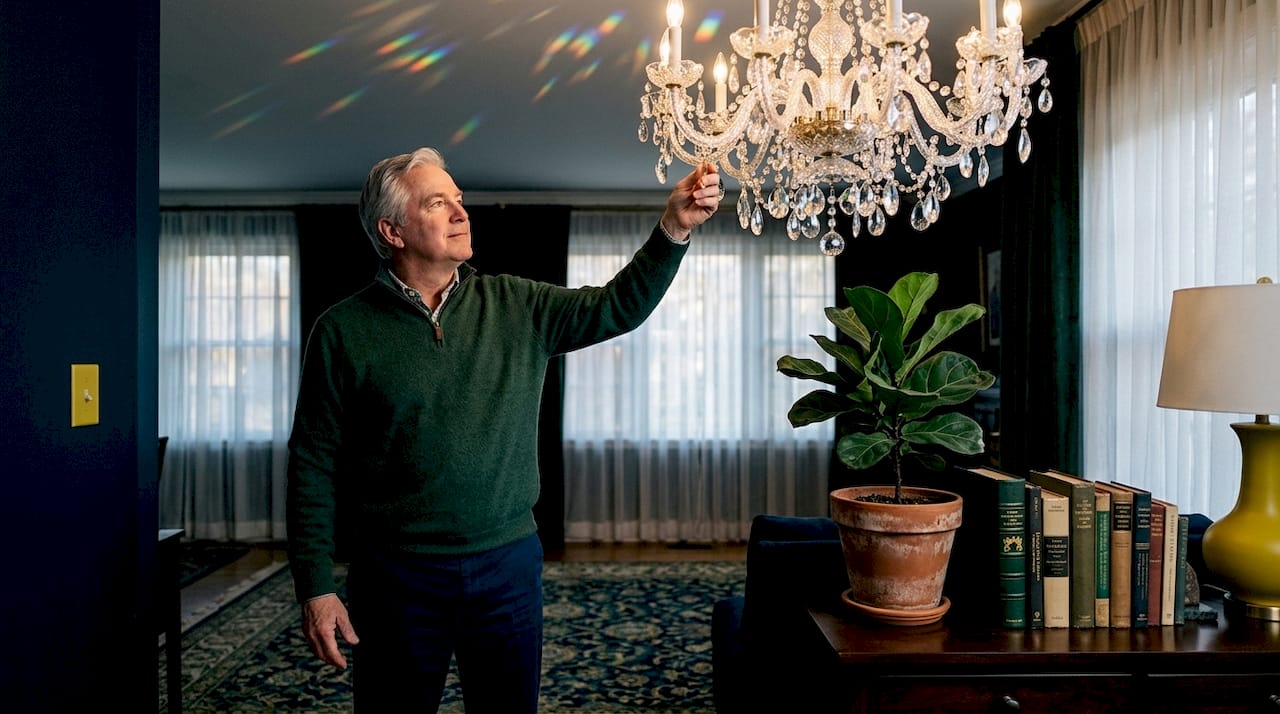
For even more crystal brilliance examples, the difference becomes especially clear in spaces where natural light enters at a strong angle, such as a foyer with a skylight or a west-facing sitting room in the afternoon. Swarovski crystals actively work with that natural light, throwing color across walls and ceilings in a way that changes throughout the day.
What Swarovski brilliance looks like in practice:
- Clean, defined rainbow projections rather than diffuse, blurry spots of color
- Warm sparkle that responds to movement and changing light angles
- A sense of visual depth in each individual drop, not just surface shine
- Cohesive light dispersion across all pieces so the fixture reads as one unified element
- Evening ambiance that feels rich and layered, not flat or harsh
Swarovski vs. other crystal and glass alternatives
Every material used in chandelier production has its place. The goal here isn’t to dismiss everything that isn’t Swarovski. It’s to give you an honest picture of where each option excels so your investment goes where it will be most appreciated.
| Material | Best use | Optical quality | Durability | Price |
|---|---|---|---|---|
| Swarovski crystal | Residential statement fixtures | Excellent | High | Premium |
| K9 optical glass | Mid-range residential, boutique commercial | Good | High | Moderate |
| Standard glass | Budget residential, rentals | Fair | Moderate | Low |
| Acrylic | High-traffic commercial, outdoor | Poor | Very high | Very low |
The core advantage Swarovski holds over K9 glass is a combination of lead oxide content and manufacturing precision. K9 is a quality optical glass that performs well, and it’s a popular choice for mid-range chandeliers. But side by side in the same light conditions, Swarovski produces richer color dispersion and a more three-dimensional sparkle. The difference is subtle on a showroom table but obvious when the fixture is installed and lit.
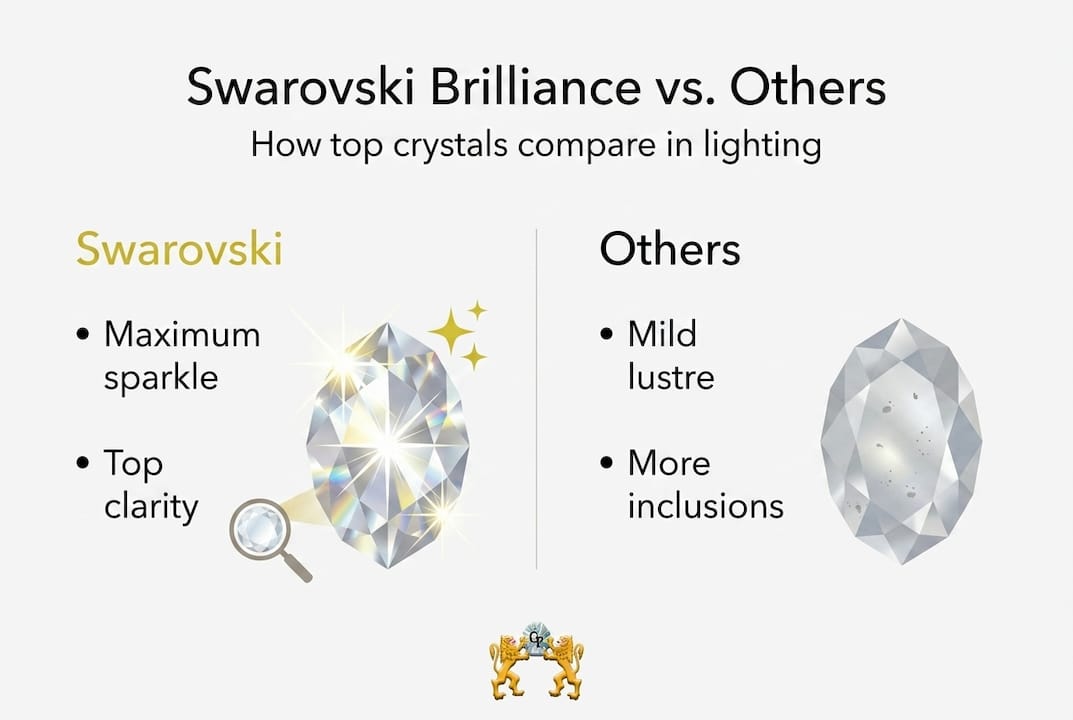
For a deeper look at Swarovski vs K9 crystals, the refractive index tells much of the story. Swarovski’s leaded formula bends light more aggressively, which is why the rainbows it produces are sharper and more vivid. K9 gets close but doesn’t quite reach the same level of definition.
Acrylic and standard glass are a different story. In high-traffic commercial spaces, cheaper acrylic or glass alternatives may outperform due to shatter resistance, but Swarovski suits residential elegance where visual performance is the primary concern. A restaurant entryway or hotel lobby with heavy foot traffic might legitimately benefit from acrylic’s resilience even if the sparkle is inferior. A private dining room or master bedroom has no such constraint, and Swarovski wins decisively in those settings.
You can also explore how Swarovski compares to generic crystals more broadly, including how generic imports often show inconsistent faceting and coloring across a single batch.
How to choose the right material for your project:
- Identify the fixture’s role. Is it a statement centerpiece or a functional overhead light?
- Consider traffic and risk. High-contact public spaces may call for more resilient materials.
- Evaluate your light sources. LED and halogen behave differently with crystal. Swarovski handles both well.
- Match your aesthetic goals. Maximum sparkle and rainbow projection demands Swarovski or leaded crystal.
- Set a realistic budget. If you can’t afford Swarovski everywhere, prioritize the focal fixture.
For a broader understanding of your options, reviewing crystal types explained can help you map materials to specific project needs with confidence.
Pro Tip: Lead content in Swarovski crystals is fully encapsulated in the glass matrix. There’s no surface exposure, and the material is completely safe for all standard decorative applications in homes, including children’s rooms.
Practical reasons to choose Swarovski for your space
Technical comparisons are useful, but the final decision usually comes down to one question: where does Swarovski actually make a difference in a real home? The answer is more specific than “everywhere,” and knowing the right spots for investment helps you get the most out of every dollar spent.
Decorating with Swarovski prisms works best in spaces where the light fixture is a visual anchor, not just a utility. Entryways, formal dining rooms, and master bedrooms are the classic candidates. In these rooms, people look up. The chandelier is intentional, designed to impress. Swarovski rewards that attention with a level of sparkle and color play that justifies the focal-point treatment.
Hospitality spaces follow the same logic. A boutique hotel lobby, a private dining room at an upscale restaurant, or a day spa reception area all benefit from the kind of ambient transformation that Swarovski produces. The goal in those environments is to create a feeling, not just provide illumination.
High clarity with minimal inclusions or bubbles maintains transparency and prevents dimming, enhancing mood lighting in interiors.
That clarity is what makes Swarovski so effective for intimate, mood-driven settings. A dimmed chandelier with Swarovski drops creates warm, golden light with living sparkle across walls and surfaces. The same fixture with cloudy or imprecise glass creates flat, slightly dull overhead light. The difference in atmosphere is night and day.
Where Swarovski delivers maximum value:
- Entry foyers with high ceilings and strong natural or overhead light
- Formal dining rooms where the chandelier is the design centerpiece
- Master bedrooms and en-suite bathrooms for elevated personal spaces
- Boutique retail environments where first impressions drive sales
- Event and hospitality spaces focused on atmosphere and guest experience
For projects where you want to understand how to transform your home with Swarovski, starting with one statement fixture is the most effective approach. That single chandelier will demonstrate the material difference clearly, making every subsequent investment decision easier. The lighting benefits of crystal go beyond aesthetics too, since genuine crystal is far more stable over time than acrylic, which yellows, or low-grade glass, which loses its coating.
Pro Tip: For maximum rainbow projection, position Swarovski chandeliers where they intersect with both artificial light and at least some natural daylight. A south- or west-facing room gives you dynamic light effects that shift throughout the day without any extra effort.
The real-world edge: Our take on choosing Swarovski
Here’s something most buying guides won’t tell you: the difference between Swarovski and a decent generic crystal is nearly invisible on a showroom table under fluorescent retail lighting. It only becomes obvious when that fixture is installed in your actual space, turned on, and allowed to interact with the room’s light sources and geometry. This is the single biggest reason buyers regret choosing cheaper alternatives for their primary fixtures.
We’ve seen this pattern repeatedly over more than three decades in this business. A homeowner chooses a non-Swarovski chandelier to save money on a dining room fixture, installs it, and finds themselves underwhelmed. The sparkle is there, but it’s soft. The rainbows are blurry rather than defined. The fixture looks fine but doesn’t transform the room the way they imagined. That’s the gap between performing adequately and performing beautifully.
The other common mistake is spreading budget too thin across too many fixtures. Choosing Swarovski for a secondary hallway light while fitting a budget crystal to the main dining chandelier is the wrong priority order. The unexpected lighting benefits of real crystal are most powerful in your most-used, most-seen spaces. Put the quality where it gets noticed.
Long-term value is also consistently underestimated. Swarovski maintains its brilliance for decades with routine care. It doesn’t yellow like acrylic, doesn’t lose its facet definition, and doesn’t cloud over time the way lower-grade glass can. The premium you pay upfront is spread across 20 or 30 years of daily enjoyment, which makes it a far more reasonable investment than the sticker price suggests.
Our honest advice: if budget forces trade-offs, buy fewer Swarovski pieces for fewer fixtures rather than covering more fixtures with generic alternatives. One spectacular statement chandelier delivers more value to your space than three mediocre ones ever will.
Enhance your space with genuine Swarovski crystals
If everything in this guide has made you want to see Swarovski brilliance in your own home, the next step is finding the right pieces for your specific project. Authentic sourcing matters enormously because the counterfeit and knock-off market for premium crystal is real and widespread.
At Crystal Place, we’ve been sourcing directly from authentic crystal brands since 1992, which means every piece in our catalog is the real thing. Whether you’re shopping for replacement drops to restore a vintage chandelier, building a new fixture from scratch, or looking for suncatchers and prisms to add sparkle to a window display, our full range of Swarovski crystal decor has you covered. We offer free shipping on orders over $22 within the USA, making it easy to experiment with a few pieces before committing to a larger project. Browse the collection and see the difference genuine quality makes.
Frequently asked questions
Are Swarovski crystals lead-free and safe for homes?
Many Swarovski crystals contain encapsulated lead oxide that is fully sealed within the glass matrix, making them safe for decorative home use, and lead-free Advanced Crystal options are also available for eco-conscious buyers.
Do Swarovski crystals lose their sparkle or turn cloudy over time?
No. Swarovski’s high clarity and minimal inclusions mean the material maintains its transparency and brilliance for decades with proper cleaning and care.
Is it worth investing in Swarovski over cheaper crystals for all fixtures?
Not necessarily for every fixture. Prioritize Swarovski for your focal-point chandelier where brilliance matters most, since acrylic and glass alternatives may be practical enough for secondary or high-traffic locations.
Are Swarovski crystals easy to clean and maintain?
Yes. Their smooth, precisely faceted surfaces resist dust buildup and respond well to gentle dusting or a mild cleaning solution, keeping them sparkling without extensive maintenance effort.
Recommended
- Dazzling Swarovski Crystals for Elegant Home Decor – CrystalPlace
- What Is Swarovski Crystal? Guide for Elegant Lighting – CrystalPlace
- Crystal Chandeliers at Your Home with Brilliance – CrystalPlace
- Chandelier crystal types explained: Brilliance & style – CrystalPlace