
Discover why use crystal beads for your craft projects. Learn how they enhance sparkle and elevate your creations to stunning new heights!
TL;DR:
- Crystal beads are made from mineral-enhanced glass with a higher refractive index, creating a sharper, prismatic brilliance unattainable by standard glass. Their precise cutting and faceting techniques, such as those by Swarovski, deliver consistent, intense sparkle ideal for statement jewelry and decorative projects. Modern lead-free formulas provide safe, high-quality options, making crystal beads a superior choice for both aesthetic impact and durability in home decor and craft applications.
Not all beads sparkle the same, and once you understand why use crystal beads instead of ordinary alternatives, your projects will never look the same. Crystal beads, technically known as crystal glass beads, are engineered with mineral additives that dramatically increase their refractive index, producing a sharp, prismatic brilliance that standard glass simply cannot match. Whether you’re stringing a statement necklace, adorning a chandelier, or crafting a window suncatcher, the material you choose determines whether your finished piece looks handmade or genuinely stunning. This article breaks down exactly what sets crystal beads apart and how to use them with confidence.
Key takeaways
| Point | Details |
|---|---|
| Crystal glass outperforms regular glass | Mineral additives raise the refractive index, delivering sharper sparkle than standard glass beads. |
| Faceting controls your design mood | More facets create formal brilliance; fewer facets produce softer, diffused glow. |
| Authenticity matters when buying | “Crystal” is often a marketing term, so verifying the actual material protects your budget and project quality. |
| Lead content affects safe use | Modern lead-free formulas maintain brilliance and are safer for children’s crafts and skin-contact jewelry. |
| Premium price reflects real quality | Crystal beads cost more than glass beads, but the visual payoff justifies the investment in visible projects. |
Why use crystal beads instead of regular glass beads
At the most basic level, crystal beads are a form of optical glass, not a naturally mined mineral. The term “crystal” in this context refers to crystal glass, a material manufactured with added minerals such as barium oxide, zinc oxide, or historically lead oxide, that push the refractive index well above ordinary glass. A higher refractive index means light bends more sharply as it passes through the bead, splitting into those vivid spectral flashes that make a finished piece look genuinely alive.
Lead oxide was used historically to achieve this effect, giving classic crystal beads their legendary fire. Modern manufacturers have shifted to lead-free formulas that preserve the same high brilliance without the associated safety concerns. If you’ve ever wondered why vintage chandelier crystals seem to sparkle with almost theatrical intensity, the lead-oxide content is a significant part of the answer. Today’s lead-free equivalents perform at a level most crafters cannot distinguish by eye.
The manufacturing precision matters just as much as the chemistry. Swarovski, the benchmark for the industry, cuts crystal to micron-level tolerance, which means every bead within a batch catches light at exactly the same angle. Mass-produced glass beads have no such consistency. You’ll notice the difference most in repetitive designs like bead curtains or chandelier strands, where irregular sparkle creates a visually noisy result instead of a unified shimmer.
Understanding the cost difference between glass and crystal also helps set expectations. Crystal beads typically run $15 to $50 or more per 100 pieces, while comparable glass beads fall in the $3 to $15 range. That gap reflects real differences in raw materials, cutting precision, and quality control. For a project that lives in a prominent spot in your home or gets worn often, spending more on crystal beads delivers visible, lasting results.
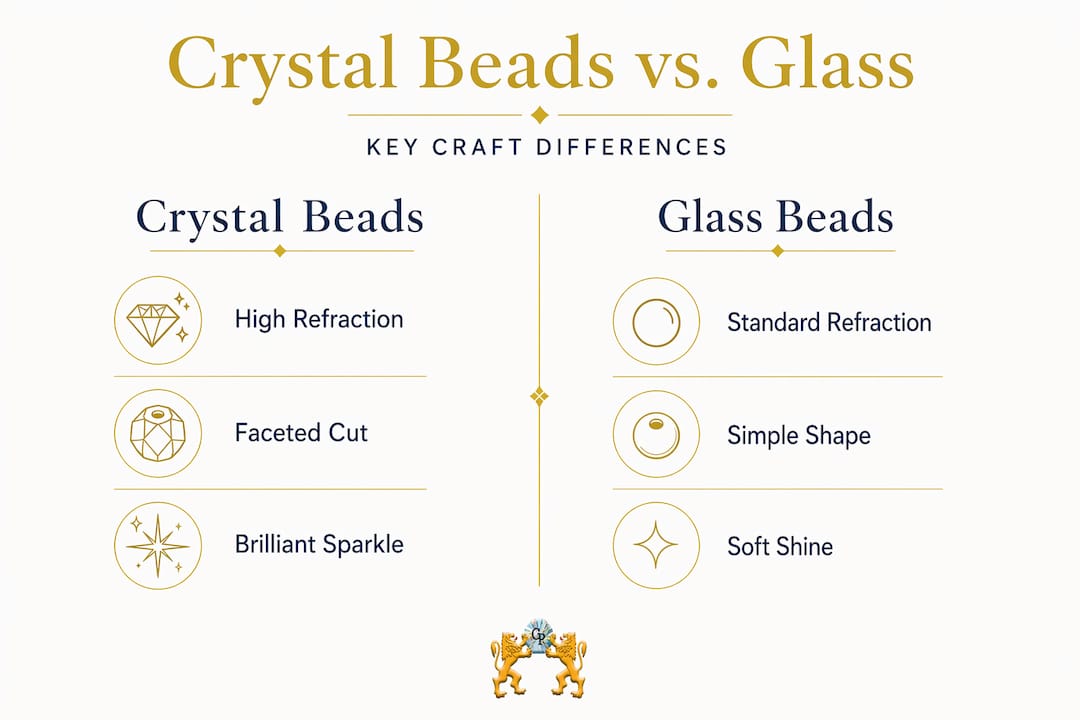
| Feature | Crystal beads | Regular glass beads |
|---|---|---|
| Refractive index | High (mineral additives) | Standard |
| Sparkle quality | Sharp, prismatic | Soft, muted |
| Cutting precision | High (faceted to tolerance) | Variable |
| Price per 100 pcs | $15–$50+ | $3–$15 |
| Best use | Statement pieces, decor | Casual crafts, fillers |
Pro Tip: When shopping online, look for sellers who specify the refractive index or name the crystal brand. Vague listings that simply say “crystal” without further detail are often glass at crystal prices.
How faceting shapes the sparkle you get
The cut geometry of a bead is the single biggest visual variable under your control as a crafter. A smooth bead acts like a lens: light passes through it and exits as one soft, diffused glow. A faceted bead behaves like a prism with multiple flat surfaces, each one bouncing light in a different direction simultaneously. Faceted beads reflect light intensely and create sparkle that moves as the bead moves, which is why chandelier crystals always feature deep, precise faceting.
Choosing between faceting styles is really a choice about design mood:
- Bicone and rondelle cuts produce a tight, symmetrical burst of light. These work well in jewelry where you want the bead itself to be the star.
- Round faceted cuts balance visual interest with softness. They’re flexible enough for both formal and casual projects.
- Briolette cuts feature facets all the way around the bead, maximizing brilliance from every viewing angle. These shine in hanging applications like suncatchers and curtain accents.
- Smooth round beads create a clean, understated look. They’re better suited to designs where another element, like metalwork or a pendant, is the focal point.
Swarovski crystal glass achieves its reputation in part because it is precision-cut with up to 100 facets per stone. More facets do not automatically mean better results for every project. In a delicate seed-bead embroidery, heavy faceting can look cluttered. But in a hanging crystal strand catching afternoon sunlight, those facets scatter light across an entire room.
Faceted beads paired with metal findings create a formal, elevated look that draws the eye even in simple jewelry designs. If you’re building a piece where every component earns its place, combining sharp crystal faceting with warm gold or cool silver findings is one of the fastest ways to make a DIY piece look professionally designed.
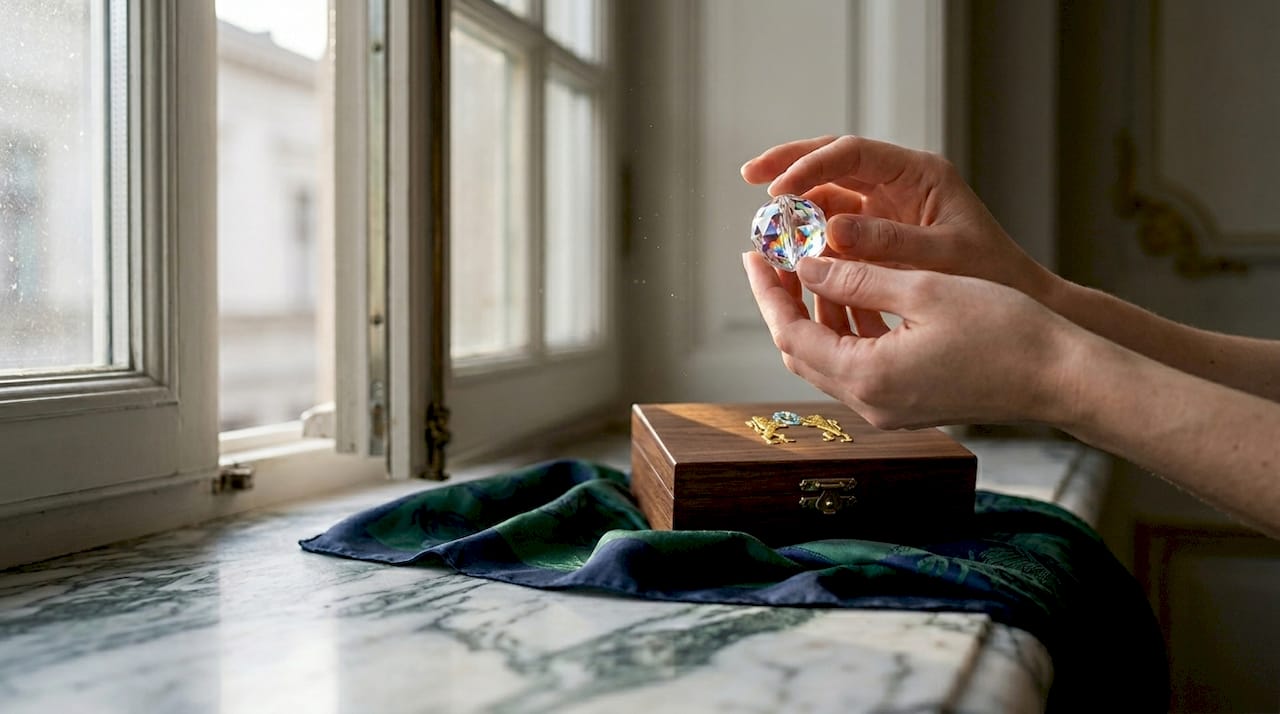
Pro Tip: For choosing facets for your design, hold a sample bead up in the same lighting environment where your finished project will live. Natural sunlight and warm indoor lighting reveal very different sparkle profiles.
Practical benefits and creative uses in home decor
The advantages of crystal beads go well beyond jewelry. Here is where this material genuinely outperforms every alternative for home-based craft projects.
-
Light enhancement in interior spaces. Crystal beads hung near a window or light source act as natural prisms, scattering rainbow light across walls and ceilings. A simple strand of faceted crystal beads in a south-facing window transforms ordinary afternoon light into a dynamic light show. This is the exact principle behind high refractive index crystals in home decor.
-
Chandelier repair and upgrade. Replacing worn or missing chandelier drops with genuine crystal beads restores the original sparkle instead of diluting it with plastic imitations. Crystal beads rated at Mohs hardness 6 to 7 resist everyday scratching better than ordinary glass, which means they maintain their clarity over years of display.
-
Suncatcher construction. Threading crystal beads onto wire or fishing line and hanging them in a window is one of the most effective weekend projects available to a DIY crafter. The faceted surfaces catch sunlight at different angles throughout the day, creating constantly shifting color patterns.
-
Jewelry with lasting visual impact. For earrings, bracelets, and necklaces that get regular wear, crystal beads hold their appearance far longer than acrylic alternatives. The scratch resistance that comes from a harder material means the surface stays clear and brilliant after years of use.
-
Embellishments on fabric and soft furnishings. Sewing individual crystal beads onto lampshades, throw pillow edges, or table runners adds a point of brilliance that catches light as fabric moves. This works especially well in spaces where ambient light is low, since the beads gather and reflect whatever light is available.
Crystal beads do require some care. They’re harder than glass but still brittle under impact, so storage in a padded container and gentle handling during stringing will protect your investment. Cleaning is straightforward: a soft cloth and mild water are all you need to restore full brilliance.
Safety, authenticity, and budget considerations
One of the most confusing aspects of shopping for crystal beads is the labeling. The word “crystal” is often used loosely by sellers as a marketing descriptor rather than a precise material designation. You can buy plastic beads, ordinary glass beads, and genuine crystal glass beads, and all three might share the same product tag. Before adding anything to your cart, ask yourself these questions:
- Does the listing specify the refractive index or name a recognizable crystal manufacturer?
- Is the price consistent with genuine crystal glass ($15 to $50+ per 100 pieces)?
- Does the seller provide documentation of material composition on request?
Lead content is the other consideration that matters more than most crafters realize. California restricts lead in jewelry and requires certification to prove compliance for items sold as children’s jewelry. Leaded crystal glass is generally considered safe for adult jewelry and home decor applications because skin exposure is minimal and brief. However, for projects that children will handle or wear, you need to confirm that the beads are certified lead-free.
The good news is that modern lead-free crystal formulations perform at a level that makes the distinction largely academic for most craft projects. Brands like Swarovski have offered lead-free options for years, and the brilliance difference is negligible in real-world use.
| Bead type | Lead content | Safe for children? | Price range |
|---|---|---|---|
| Traditional leaded crystal | Present | Not recommended | $20–$50+ per 100 pcs |
| Lead-free crystal glass | None | Yes, with certification | $15–$45 per 100 pcs |
| Standard glass | None | Yes | $3–$15 per 100 pcs |
| Acrylic/plastic | None | Yes | $1–$8 per 100 pcs |
Transparency in material labeling builds real confidence in your purchasing decisions. Stick with suppliers who clearly state what they’re selling and stand behind it with documentation. For children’s crafts or prolonged skin-contact jewelry, confirming lead content and verifying certification is a practical step you will not regret.
My honest take on using crystal beads in craft projects
I’ve watched crafters spend hours on a piece using beautiful wire work, careful knotting, and thoughtful color combinations, and then undermine all of it with beads that look dull the moment natural light hits them. That’s the thing nobody tells you clearly enough: the bead material is not a secondary decision. It’s often the primary one.
In my experience, when you hold a genuinely faceted crystal bead up to a window for the first time, you understand immediately why it commands a higher price. The light doesn’t just pass through it. It performs. That difference in visual behavior directly affects how the finished piece makes you feel when you look at it, and how it makes others feel when they see it on display or worn.
What I’ve found is that crafters who upgrade from plastic or basic glass to real crystal beads rarely go back, even for budget projects. The investment recalibrates your expectations in a way that actually sharpens your overall design sense. You start thinking more carefully about where sparkle belongs and where restraint serves the piece better. You can explore the full range of crystal bead types to understand which cut and material pairing fits each project before you commit.
My recommendation: start with one small project using authentic crystal beads, place it somewhere you’ll see it daily, and watch how the space around it changes. The decision to keep using them will make itself.
— BCC
Discover crystal beads and decor at Crystalplace
If you’re ready to bring real crystal brilliance into your craft projects, Crystalplace has sourced authentic Swarovski and premium crystal products since 1992. The selection covers everything from individual crystal beads to full chandelier components, all verified for quality and brilliance. Whether you’re repairing a chandelier, building a suncatcher, or designing statement jewelry, you’ll find the right cut and size without guessing at material quality.
Browse the full collection of crystal prisms and beads for home decor and craft projects, or go straight to the Swarovski crystal suncatchers to see what precision-cut crystal looks like in a ready-to-hang format. Free shipping on orders over $22 within the USA.
FAQ
What makes crystal beads different from glass beads?
Crystal beads are made from crystal glass with mineral additives that increase the refractive index, producing sharper, more prismatic sparkle than standard glass. The cutting precision of crystal beads also tends to be significantly higher, which means more consistent brilliance across a full strand.
Are crystal beads safe for children’s jewelry projects?
Modern lead-free crystal beads are generally safe for children’s projects, but you should confirm that the specific beads you buy are certified lead-free, especially for items sold in states like California that have strict lead regulations for children’s jewelry.
Why choose crystal beads over acrylic or plastic beads?
Crystal beads offer far superior light refraction, scratch resistance in the Mohs 6 to 7 range, and a clarity that plastic cannot replicate. For any project displayed in natural light or worn regularly, crystal beads maintain their appearance and visual impact far longer than plastic alternatives.
What are crystal beads used for in home decor?
Crystal beads work in chandelier repair and assembly, window suncatchers, bead curtains, embellished lampshades, and hanging light accents. Their prismatic faceting scatters light across a room, making them one of the most effective decorative materials for brightening interior spaces.
How do I verify that crystal beads are authentic?
Look for sellers who name the crystal manufacturer, specify the refractive index, or provide material documentation. Price is also a strong signal: genuine crystal glass beads typically cost $15 to $50 or more per 100 pieces, well above the range of glass or plastic alternatives labeled as “crystal.”
Recommended
- Discover crystal beads: illuminate your home with brilliance – CrystalPlace
- Create Your Dream Space With Intricate Crystal Ornaments – CrystalPlace
- Transform Your Space with Crystal Strands & Garlands – CrystalPlace
- Crystal ornaments: types, sparkle, and home decor uses – CrystalPlace